Last reviewed: September 23, 2026
Last updated: September 23, 2026
Written by: Jay Hastings, CEO of PlexusDx
Jay Hastings is the CEO of PlexusDx, a precision health company focused on genetic testing, blood biomarker insights, and personalized wellness recommendations. He has more than 20 years of experience across healthcare innovation, genomics, laboratory operations, healthcare investing, and strategic finance. His work has included scaling healthcare startups, leading CLIA lab integrations, and helping expand consumer access to precision health tools.
Medically reviewed by: Jayden Lee, PharmD, EMBA
Jayden Lee, PharmD, EMBA, is the PlexusDx Medical Science Liaison with a PharmD and MBA specializing in pharmacogenomics and clinical product development, with a proven ability to bridge the gap between genomic research and practical patient outcomes. Dr. Lee has more than 10 years of professional experience in clinical pharmacy, academia, and research.
PlexusDx publishes this comparison and is one of the providers discussed. We use the same evidence rules for our own program and competing programs.
The short answer
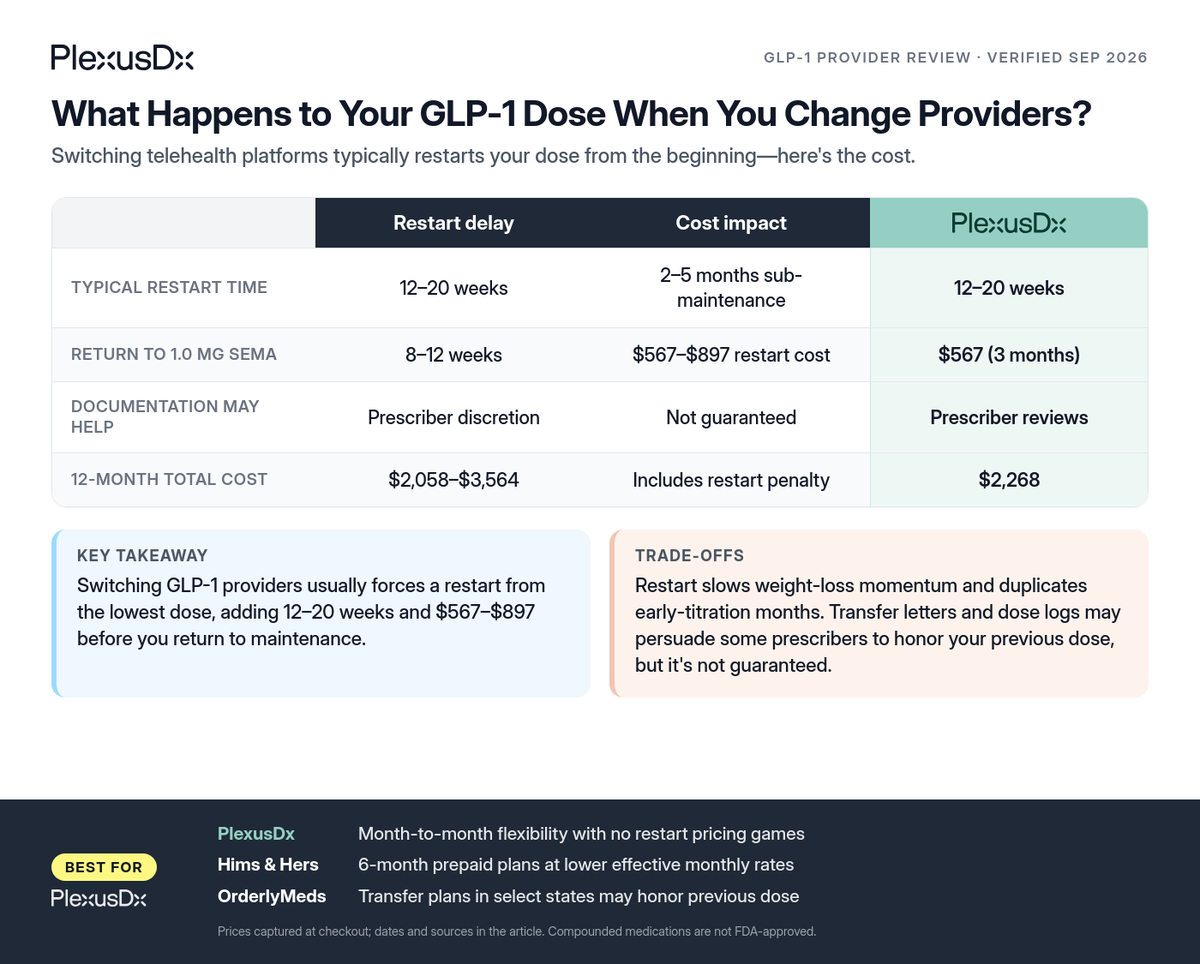
When you switch GLP-1 providers, your dose titration typically restarts from the beginning. Most telehealth platforms begin you at the lowest FDA-recommended starting dose—0.25 mg weekly for semaglutide injection or 2.5 mg weekly for tirzepatide injection—even if you were stable at a higher dose with your previous provider. The reason is medical and legal: a new prescriber must independently assess your tolerance, side effects, and response history before authorizing continuation at a higher dose. The prescriber at your new provider has no direct access to your previous medical records unless you arrange a formal transfer, and liability standards require them to establish their own baseline. This restart can mean weeks or months of re-titration, possible return of side effects you had already worked through, and interruption of your weight-loss momentum.
Planning a provider switch or starting fresh?
Compare upfront dose policies, restart protocols, and total monthly costs across platforms.
See all GLP-1 protocols →
At a glance: why dose restarts happen
| Factor |
Why It Forces a Restart |
| No shared medical record |
The new prescriber cannot see your previous dosing history, side-effect log, or tolerance notes unless you proactively transfer records. |
| Liability and independent assessment |
Each prescriber is independently liable. Starting you mid-titration without their own observation exposes them to risk if you experience adverse events. |
| Different compound or formulation |
If your previous provider used branded Wegovy and your new provider dispenses compounded semaglutide, the prescriber may elect to restart titration even though the active ingredient is the same, because compounded medications are not FDA-approved and formulation may differ. |
| Protocol differences |
Some platforms follow accelerated titration schedules; others adhere strictly to manufacturer labeling. The new provider's protocol may not match your previous trajectory. |
| State and licensing constraints |
Telehealth prescribers are licensed per state. If the new prescriber practices under different state board rules, they may be required to conduct a full initial assessment before prescribing any controlled or restricted medication. |
The practical result: if you were stable at semaglutide 1.0 mg weekly with your previous provider, expect your new provider to start you at 0.25 mg and re-titrate over 16–20 weeks to reach 1.0 mg again, following the standard four-week intervals between dose increases.
How much restart time and cost does a provider switch add?
Re-titration from the lowest starting dose to your previous maintenance dose typically adds 12–20 weeks and the associated monthly costs. The table below models a switch scenario for a patient who was stable at semaglutide 1.0 mg weekly (a common maintenance dose) and must restart titration at 0.25 mg with a new provider.
| Scenario Element |
Standard Titration Schedule |
Cost Impact (month-to-month example) |
| Starting dose |
0.25 mg weekly (weeks 1–4) |
Month 1 payment at provider's standard rate |
| First increase |
0.5 mg weekly (weeks 5–8) |
Month 2 payment |
| Second increase |
1.0 mg weekly (weeks 9–12+) |
Month 3 payment; you reach your previous maintenance dose |
| Total restart delay |
8–12 weeks to return to 1.0 mg |
2–3 months of sub-maintenance dosing and payments |
| Higher-dose restart |
If you were at 2.0 mg or 2.4 mg, add 8–16 more weeks |
4–7 total months to return to your previous dose |
At $189 per month (PlexusDx semaglutide injection month-to-month rate, captured July 17–23, 2026), restarting from 0.25 mg to reach 1.0 mg again costs you $567 over 12 weeks before you resume your previous dose. At $299 per month (MEDVi semaglutide injection refill rate, captured September 4, 2026), the same restart window costs $897. These figures assume the provider charges the same rate at every dose; some platforms use per-dose pricing, which can lower early-titration costs but still imposes a time delay.
Provider-by-provider dose-restart and continuity policies
Not all telehealth platforms treat dose transfers the same way. The table below shows which providers explicitly require restart titration, which may honor your previous dose under certain conditions, and what documentation or process each requires.
| Provider |
Dose Continuity Policy |
Documentation Required |
Typical Restart Timeline |
| PlexusDx |
Restart from 0.25 mg or 2.5 mg unless previous records transferred and reviewed by prescriber |
Previous prescription history, dose log, and side-effect notes; prescriber discretion |
12–20 weeks to return to 1.0 mg+ semaglutide or 5.0 mg+ tirzepatide |
| Hims & Hers |
Standard restart; may consider previous dose if records provided |
Prescription history or previous provider's clinical notes |
12–20 weeks |
| Found |
Restart per clinician protocol; some continuity if transferring records proactively |
Previous dose and tolerance documentation |
12–20 weeks |
| Ro |
Standard restart unless transferring from another Ro-affiliated program |
Clinical intake and previous prescription records |
12–20 weeks |
| Henry Meds |
Restart titration standard; previous dose may be considered with documentation |
Prescription bottle photo or clinical records |
12–20 weeks |
| Mochi Health |
Per-dose pricing allows restart at any level prescriber approves |
Previous dose and tolerance history |
Variable; prescriber may approve faster re-titration |
| Eden |
Standard restart; clinician reviews previous records if provided |
Previous prescription or medical records |
12–20 weeks |
| MEDVi |
Restart standard; prescriber discretion if transferring records |
Previous prescription or dose log |
12–20 weeks |
| OrderlyMeds |
Multi-month transfer plans available in some states; otherwise restart |
Transfer plan enrollment and previous prescription verification |
May honor previous dose in transfer-plan states; otherwise 12–20 weeks |
Source: provider websites and intake flows captured July 17–September 4, 2026. Policies reflect general platform practice; individual prescriber decisions may vary.
The key variable is prescriber discretion. Even when a platform's stated policy is to restart, a clinician may approve continuation at your previous dose if you provide comprehensive documentation—prescription bottle with dose and date, a letter from your previous provider, and a detailed tolerance log. However, this exception is not guaranteed, and the default across the industry is restart titration.
Avoid restart delays with a provider that honors your dose
Complete a short intake and a licensed clinician will review your previous dose history and current fit for continuation.
Start My 60-Second Intake →About 60 seconds · $0 charged until provider approval.
The cost of restart: 12-month comparison when you switch mid-year
Switching providers mid-treatment adds cost beyond the obvious monthly rate difference. The table below models a 12-month scenario in which a patient switches providers at month 7, having reached semaglutide 1.0 mg maintenance with their original provider. The new provider restarts titration at 0.25 mg, and the patient spends months 7–9 re-climbing to 1.0 mg before resuming maintenance.
| Provider |
Months 1–6 (Original Provider) |
Months 7–12 (New Provider, Restart Included) |
Total 12-Month Cost |
| PlexusDx semaglutide injection (month-to-month) |
6 × $189 = $1,134 |
6 × $189 = $1,134 |
$2,268 |
| Hims & Hers compounded semaglutide (6-month prepaid) |
$1,194 upfront (6 months prepaid at $199/mo effective) |
$1,194 upfront for months 7–12 |
$2,388 |
| Henry Meds compounded semaglutide (month-to-month) |
6 × $297 = $1,782 |
6 × $297 = $1,782 |
$3,564 |
| MEDVi compounded semaglutide (month-to-month) |
$179 (month 1 first-month introductory rate) + 5 × $299 = $1,674 |
$179 (month 7 restart first-month rate) + 5 × $299 = $1,674 |
$3,348 |
| Found GLP-1 Program cash-pay (month-to-month, medication included) |
6 × $289 = $1,734 |
6 × $289 = $1,734 |
$3,468 |
| Eden compounded semaglutide (medication + membership) |
$39 (month 1 first-month membership) + 5 × $198 = $1,029 |
$39 (month 7 restart first-month membership) + 5 × $198 = $1,029 |
$2,058 |
Rates and calculation notes: PlexusDx semaglutide injection $189/month month-to-month (captured July 17–23, 2026). Hims & Hers compounded semaglutide 6-month prepaid $1,194 ($199/month effective; captured September 4, 2026). Henry Meds compounded semaglutide injection $297/month month-to-month (captured July 17–23, 2026). MEDVi compounded semaglutide injection $179 first month, $299 each refill (captured September 4, 2026); restart at month 7 repeats the $179 first-month introductory rate. Found GLP-1 Program cash-pay $289/month month-to-month, medication included (captured July 20 and September 4, 2026). Eden compounded semaglutide $39 first-month membership, then $99 membership + $99 medication = $198/month ongoing (captured July 17–23 and September 4, 2026); restart at month 7 repeats the $39 first-month introductory membership. All 12-month totals are our calculation. No figures account for potential lapses in medication supply during the provider transition, which could add further cost or delay.
The restart penalty ranges from $0 (when both providers charge the same flat rate and honor restart introductory pricing, as in the MEDVi and Eden models) to several hundred dollars in lost momentum and duplicated ramp-up months. The hidden cost is clinical: spending months 7–9 at sub-maintenance doses may slow or reverse your weight-loss progress, requiring you to regain ground you had already covered.
What you can do to minimize restart delays
While most providers default to restart titration, a few steps improve your chances of dose continuity:
-
Request a transfer letter from your current provider. Ask for a formal letter on letterhead stating your current dose, start date, titration history, and any side effects or tolerance notes. This is not a prescription—it is a clinical summary that the new prescriber can review during intake.
-
Photograph your prescription bottle and medication packaging. A clear image showing the drug name, dose, pharmacy, and dispense date serves as contemporaneous evidence of your current regimen.
-
Maintain a dose and side-effect log. A simple spreadsheet noting each dose change, the date, and any nausea, fatigue, or other reactions helps the new clinician assess your tolerance trajectory without repeating the entire observation period.
-
Ask the new provider's policy before switching. During intake or the initial consult, explicitly ask whether they will honor your previous dose if you provide documentation. Some platforms have internal protocols that allow prescribers to skip restart if the evidence is robust.
-
Time the switch to align with a refill or dose plateau. Switching when you have been stable at a maintenance dose for several months—rather than mid-titration—strengthens your case for dose continuity, because the new prescriber can see a clear tolerance track record. If you have been at 1.0 mg semaglutide for three months with no issues, your case for continuity is stronger than if you just moved from 0.5 mg to 1.0 mg last week.
-
Consider staying with your current provider if dose continuity is critical. If you are approaching your goal weight or managing the final stages of titration, the cost and delay of a restart may outweigh any monthly rate savings from switching. Run the 12-month cost comparison above before making the move.
Why compounded-to-compounded or branded-to-compounded switches often require restarts
Even when the active pharmaceutical ingredient is identical—semaglutide to semaglutide, tirzepatide to tirzepatide—a switch from one compounded formulation to another, or from branded to compounded, often triggers a restart. The reason is regulatory and clinical:
Compounded medications are not FDA-approved. FDA does not review compounded drugs before marketing for safety, effectiveness, or quality. A licensed clinician determines whether a prescription is appropriate for an individual patient. Because compounded formulations may differ in excipients, concentration accuracy, and delivery mechanism (even among the same active ingredient), a new prescriber may elect to start you at the lowest dose to observe how your body responds to their specific compound. This is not a reflection on the quality of your previous provider's compound—it is a standard risk-mitigation practice when the new formulation has not been directly compared to the old one in your individual case.
Branded-to-branded switches (Wegovy to Wegovy, Zepbound to Zepbound) at the same dose are more likely to be honored, because the FDA-approved product is standardized. However, even here, if you are switching from a branded injection to a branded oral formulation, or from one branded product to a different GLP-1 agonist (semaglutide to tirzepatide), re-titration is standard.
Choose PlexusDx if you want transparent month-to-month dosing with no restart pricing games
PlexusDx charges the same rate at every dose—$189/month for semaglutide injection or $289/month for tirzepatide injection, month-to-month—so if a restart is unavoidable, you pay the same $189 or $289 whether you are at 0.25 mg or 2.4 mg (rates captured July 17–23, 2026). No introductory discount that inflates to a higher refill rate, no multi-month prepay required, and no hidden membership fees. If you provide documentation of your previous dose and the prescriber determines continuity is appropriate, you may resume at your previous level; if a restart is required for safety, you re-titrate at the same transparent rate. PlexusDx works with licensed 503A compounding pharmacies, and every prescription decision rests with a licensed clinician after reviewing your individual history and tolerance. The intake is about 60 seconds, and $0 is charged until a provider approves your prescription.
Choose Hims & Hers if you prefer prepaid six-month blocks and can tolerate restart titration
Hims & Hers compounded semaglutide is $199 per month when you prepay six months ($1,194 upfront; captured September 4, 2026). The six-month commitment locks in the rate but also means that if you switch to Hims mid-treatment and must restart titration, you prepay for six months that include your restart ramp-up period. If you were already at maintenance with another provider and the restart moves you back to 0.25 mg, you spend the first 8–12 weeks of your prepaid block re-climbing to your previous dose. Hims offers both compounded semaglutide injections and branded Wegovy, Ozempic, Zepbound, and Mounjaro options where available, plus oral formulations, giving you flexibility if your clinician recommends a different route mid-treatment. Cancellation and refund terms are tied to the six-month prepay structure, so confirm those details at checkout if you anticipate needing to pause or adjust before the six months elapse.
Choose Found if you value integrated coaching and can absorb the higher all-in cost during restart
Found's GLP-1 Program cash-pay plan is $289 per month month-to-month (medication included; captured July 20 and September 4, 2026) or $169 per month when you prepay annually ($2,028 upfront). The program includes dedicated health coaching, nutritional guidance, and behavioral support alongside your medication, which can be valuable during the restart phase when motivation and side-effect management are critical. However, the $289 monthly rate (or $169 prepaid equivalent) applies whether you are at 0.25 mg restart or 2.4 mg maintenance, so if you switch to Found mid-treatment and must re-titrate, you pay the full program fee during those restart months. Found dispenses both compounded semaglutide and tirzepatide injections and offers branded GLP-1 options; the cash-pay rate covers compounded medication, while branded prescriptions are billed separately if your clinician prescribes them. If you are switching from another provider and want hands-on support through the restart period, Found's coaching infrastructure may justify the higher monthly cost. The annual prepay offers significant savings ($2,028 vs. $3,468 over 12 months, our calculation), but you must commit upfront, and refund terms are limited.
Choose Henry Meds if you are comfortable with month-to-month flexibility at a higher rate
Henry Meds compounded semaglutide injection is $297 per month month-to-month (captured July 17–23, 2026), with six-month prepaid options at $1,782 or $1,482 and twelve-month options at $3,564 or $2,364 (the lower prepay figures reflect promotional discounts verified at capture). The month-to-month structure gives you flexibility to pause or switch again if the restart does not go smoothly, but the $297 baseline is among the higher rates in the compounded telehealth market. Henry Meds also offers compounded semaglutide in tablet, drop, and injection forms, plus oral tirzepatide and liraglutide injection, so if your restart experience suggests a different formulation might suit you better, the platform has options. However, the research packet notes that tirzepatide is offered only as an oral dissolving tablet, not injection, which is unusual and may limit your choices if you were previously on tirzepatide injection elsewhere. The legal program page contains two apparent copy inconsistencies (captured September 4, 2026), so verify all terms and medication forms directly at checkout before committing.
Choose Ro if you prefer a separate membership model and have budget for higher branded-medication costs
Ro's Body Program membership is $149 per month monthly, $89 per month on a six-month prepay ($534 upfront), or $74 per month on an annual prepay ($888 upfront; captured September 4, 2026). Medication is billed separately: Wegovy pill $149–$299 per month depending on dose, Zepbound $299–$449 per month depending on dose (captured September 4, 2026). This tiered structure means that if you switch to Ro mid-treatment and must restart titration, you pay a lower medication cost during your restart months (starting dose = lower tier) but still carry the $149 monthly membership (or prepaid equivalent). Over 12 months, the membership alone is $1,788 (monthly) or $888 (annual prepaid, our calculation), and the medication cost stacks on top. Ro offers branded Wegovy pen and pill, Zepbound, Ozempic, and Mounjaro, which may appeal if you want FDA-approved products rather than compounded alternatives. However, the combined membership-plus-medication structure makes Ro one of the more expensive options if you are paying out-of-pocket, and the restart delay will extend the period before you reach the higher (and more expensive) maintenance-dose tiers.
Choose MEDVi if you want a low first-month entry and are comfortable with the refill-rate jump
MEDVi compounded semaglutide injection is $179 for the first month, then $299 each refill; dose increases do not raise the price (captured September 4, 2026; checkout verified). Compounded tirzepatide injection is $279 first month, $399 each refill. If you switch to MEDVi mid-treatment and must restart titration, you benefit from the $179 first-month introductory rate again at month 7 (as modeled in the 12-month cost table above), but you then climb back to the $299 refill rate for months 8–12. This yo-yo pricing can make budgeting harder, but the $179 entry point lowers the immediate cash outlay when you are restarting from zero. MEDVi also offers compounded semaglutide tablets (injection price plus $70), tirzepatide injection and oral options, and branded Wegovy and Zepbound pathways at $99 membership plus medication cost. The program is month-to-month with no contract and cancel-anytime terms, giving you flexibility if the restart does not go as planned. However, the first-month-versus-refill structure means you should plan for the higher ongoing rate when calculating your 12-month budget, and confirm at checkout that the refill rate applies to every subsequent month, not just the second.
Methodology and freshness
This article uses pricing, policy, and dose-restart data captured from provider websites, checkout flows, and verified program pages between July 17 and September 4, 2026. All per-provider rates and policies are sourced from the research packet compiled on September 23, 2026. Dose-restart timelines (12–20 weeks to return to 1.0 mg semaglutide or 5.0 mg tirzepatide from the starting dose) reflect standard FDA titration schedules published in Wegovy and Zepbound prescribing information, applied to compounded and telehealth settings where the same titration intervals are typically observed. The 12-month cost comparisons are our calculation, modeling a mid-year provider switch at month 7 with restart titration beginning at that month. Figures labeled "our calculation" derive from the captured per-month or prepaid rates using straightforward multiplication; no discount arithmetic or extrapolation is applied. Where a provider offers an introductory rate (e.g. MEDVi $179 first month), the model applies that rate once at the initial start and once at the restart month, then uses the refill rate for all other months. Compounded medication disclosure: compounded medications are not FDA-approved. FDA does not review compounded drugs before marketing for safety, effectiveness, or quality. A licensed clinician determines whether a prescription is appropriate for an individual patient. PlexusDx works with licensed 503A compounding pharmacies. This comparison reflects commercial terms only and does not guarantee that any provider will approve dose continuity or restart at a specific level; individual prescriber decisions depend on your medical history, documentation, and tolerance assessment.
Frequently Asked Questions
Will my new GLP-1 provider honor my current dose if I switch?
Most telehealth GLP-1 providers restart titration at the lowest FDA-recommended dose when you switch, even if you were stable at a higher dose elsewhere. A new prescriber must independently assess your tolerance and cannot rely on another provider's records unless you proactively transfer comprehensive documentation—prescription history, dose log, and side-effect notes—and the clinician determines that continuation is safe and appropriate.
How long does re-titration take if I have to restart my dose?
Restarting semaglutide injection from 0.25 mg to reach 1.0 mg maintenance typically takes 8–12 weeks, following the standard four-week intervals between dose increases. If you were at 2.0 mg or 2.4 mg with your previous provider, returning to that level can take 16–20 weeks or more, depending on your tolerance and the new prescriber's titration protocol.
Does switching from branded Wegovy to compounded semaglutide require a restart?
Often, yes. Even though the active ingredient is the same, compounded medications are not FDA-approved and may differ in formulation, excipients, and concentration accuracy. A new prescriber may elect to restart you at the lowest dose to observe how you respond to their specific compound, as a standard risk-mitigation practice when the new formulation has not been directly compared to the old one in your case.
Can I avoid a dose restart by timing my provider switch carefully?
Switching when you have been stable at a maintenance dose for several months—rather than mid-titration—strengthens your case for dose continuity, because the new prescriber can see a clear tolerance track record. Providing a formal transfer letter, prescription bottle photo, and dose log also improves your chances, though no strategy guarantees that the new provider will honor your previous dose without independent re-assessment.
Does PlexusDx charge more during re-titration months if I have to restart?
No. PlexusDx charges the same month-to-month rate at every dose—$189 for semaglutide injection, $289 for tirzepatide injection—so whether you are restarting at 0.25 mg or continuing at 2.4 mg, the price is identical. There is no introductory discount followed by a higher refill rate, and no multi-month prepay required to access the standard rate.
Sources
- PlexusDx semaglutide and tirzepatide injection pricing and dose policy (captured July 17–23, 2026; plexusdx.com)
- Hims & Hers compounded semaglutide pricing and program structure (captured September 4, 2026; forhims.com, forhers.com)
- Ro Body Program membership and medication pricing (captured September 4, 2026; ro.co)
- Found GLP-1 Program pricing and coaching inclusions (captured July 20 and September 4, 2026; getfound.com)
- Henry Meds compounded semaglutide and tirzepatide pricing, formulations (captured July 17–23 and September 4, 2026; henrymeds.com)
- MEDVi compounded semaglutide and tirzepatide pricing, introductory and refill rates, checkout verification (captured September 4, 2026; medvi.com)
- Wegovy (semaglutide) Prescribing Information, FDA-approved titration schedule (accessed September 23, 2026; novo-pi.com/wegovy.pdf)
- Zepbound (tirzepatide) Prescribing Information, FDA-approved titration schedule (accessed September 23, 2026; pi.lilly.com/us/zepbound-uspi.pdf)
- OrderlyMeds compounded semaglutide and tirzepatide starter and ongoing pricing, multi-month transfer plan availability (captured September 4, 2026; orderlymeds.com)
- PlexusDx Trustpilot rating: 4.3 stars, 79% five-star, 83% four-star or higher (captured September 9, 2026; trustpilot.com/review/plexusdx.com)
Ready to start or switch without the restart penalty?
One all-inclusive price covers your online provider visit, prescription, medication, and shipping—no membership, no hidden fees. Complete a short intake and a licensed provider reviews your fit.
Start My Intake →
Compounded medication disclosure: Compounded medications are not FDA-approved. FDA does not review compounded drugs before marketing for safety, effectiveness, or quality. A licensed clinician determines whether a prescription is appropriate for an individual patient. PlexusDx works with licensed 503A compounding pharmacies.
Medical and Editorial Standards
Medical review process: This article was reviewed for medical accuracy, scientific clarity, evidence alignment, and appropriate discussion of genetics, medications, supplements, biomarkers, and health-related claims.
Sources and evidence: PlexusDx educational content is developed using peer-reviewed research, clinical literature, reputable medical references, and, where applicable, public health or regulatory guidance. References are included at the end of the article when scientific, medical, or health-related claims are discussed.
Commercial transparency: PlexusDx offers genetic testing, blood biomarker testing, personalized supplement recommendations, and related precision wellness services. Product mentions are intended to help readers understand available options and should not be interpreted as medical advice.
Important disclaimer: PlexusDx educational content is for informational purposes only and should not be used as a substitute for professional medical advice, diagnosis, or treatment. Always consult a qualified healthcare provider before making decisions about medications, supplements, genetic testing, lab testing, or health-related care.


Share:
ReflexMD Hidden Fees: Provider Visits, Labs, Shipping, and Medication
GLP-1 Provider Transfer Checklist: Prescription, Dose and Shipping