

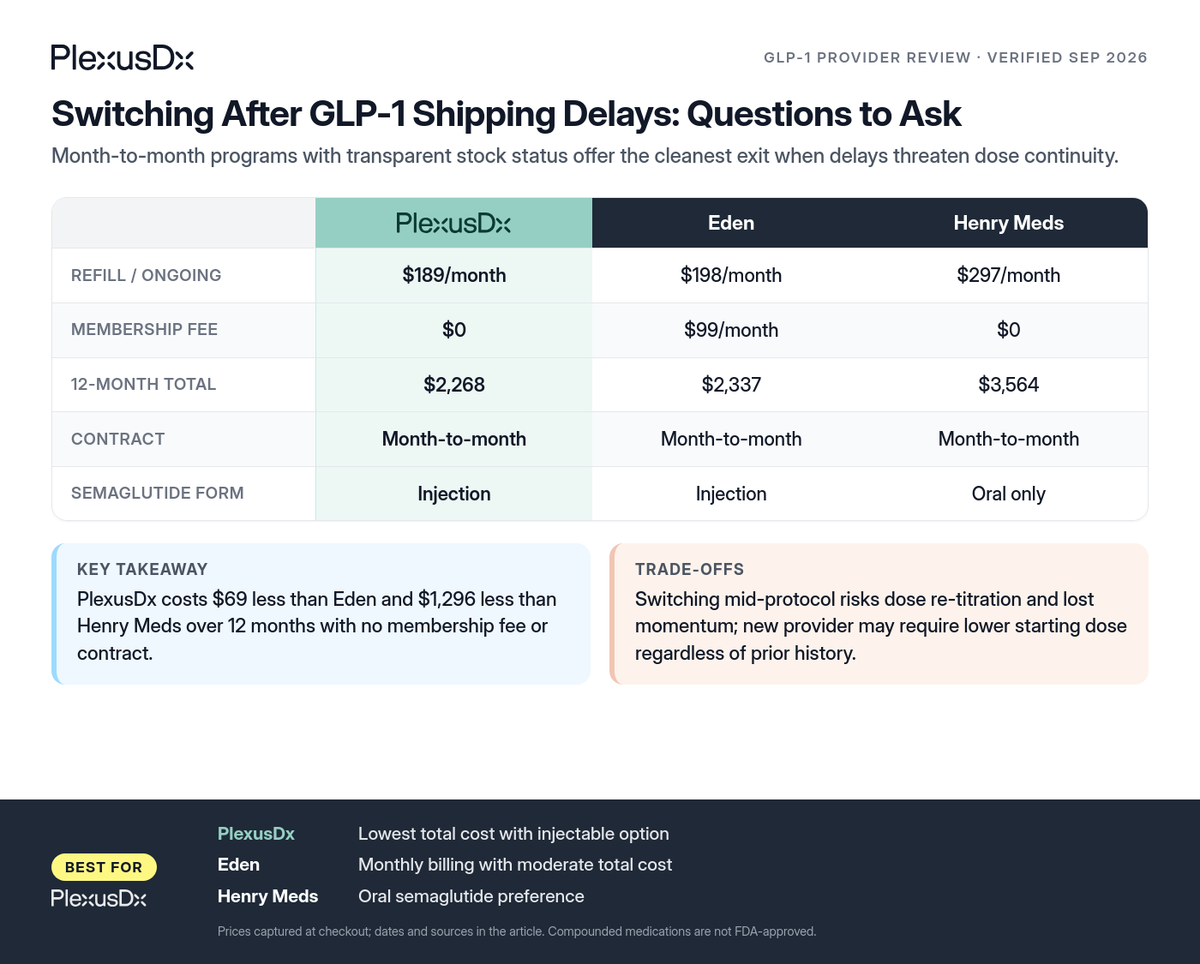
Switching After GLP-1 Shipping Delays: Questions to Ask in 2026
When a shipping delay interrupts your GLP-1 protocol, switching safely requires asking four questions: how long is the gap, what's my current dose, will the new pharmacy honor it, and what happens to prepaid funds?
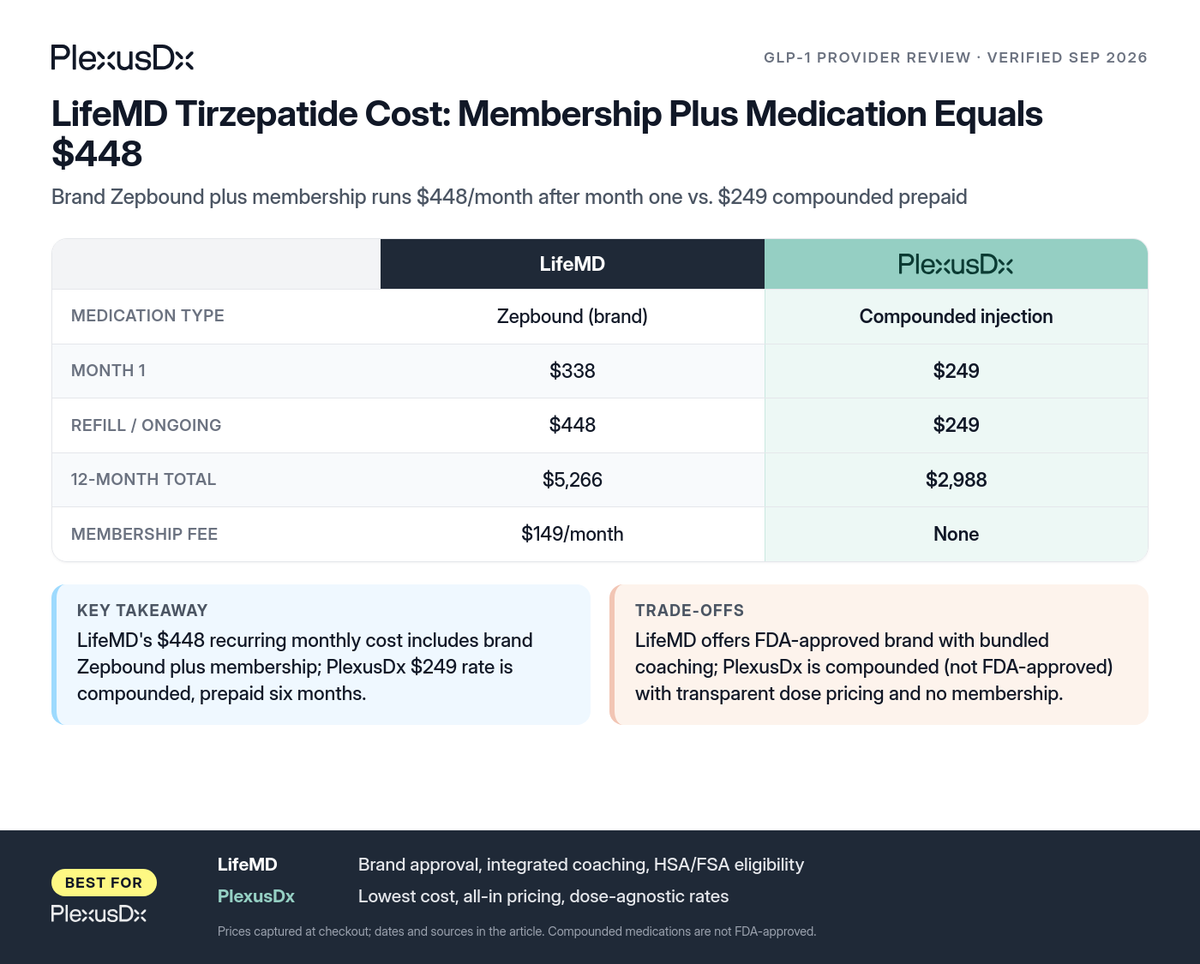
LifeMD Tirzepatide Cost: Membership Plus Medication Equals $448
LifeMD charges $299/month for brand-name Zepbound tirzepatide plus a monthly membership (first month at an introductory rate, then $149 ongoing), totaling $448/month after month one. We compare the all-in cost against compounded alternatives.
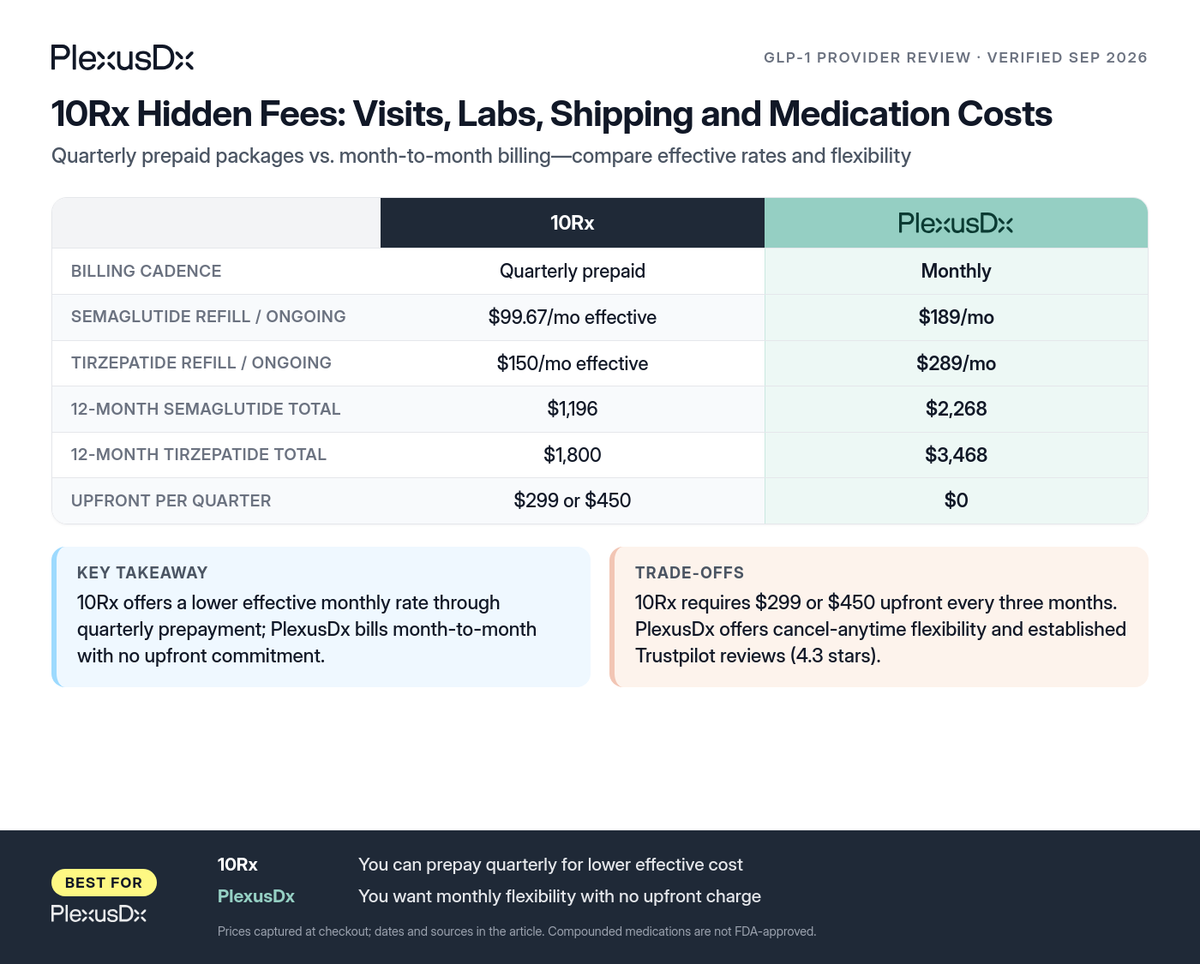
10Rx Hidden Fees: Visits, Labs, Shipping and Medication Costs
10Rx bundles clinician evaluation, next-day shipping, and support into its quarterly prepaid packages with no separate membership or per-visit fees. We break down what's included, the upfront quarterly cost, and how the effective monthly rate compares to month-to-month alternatives.
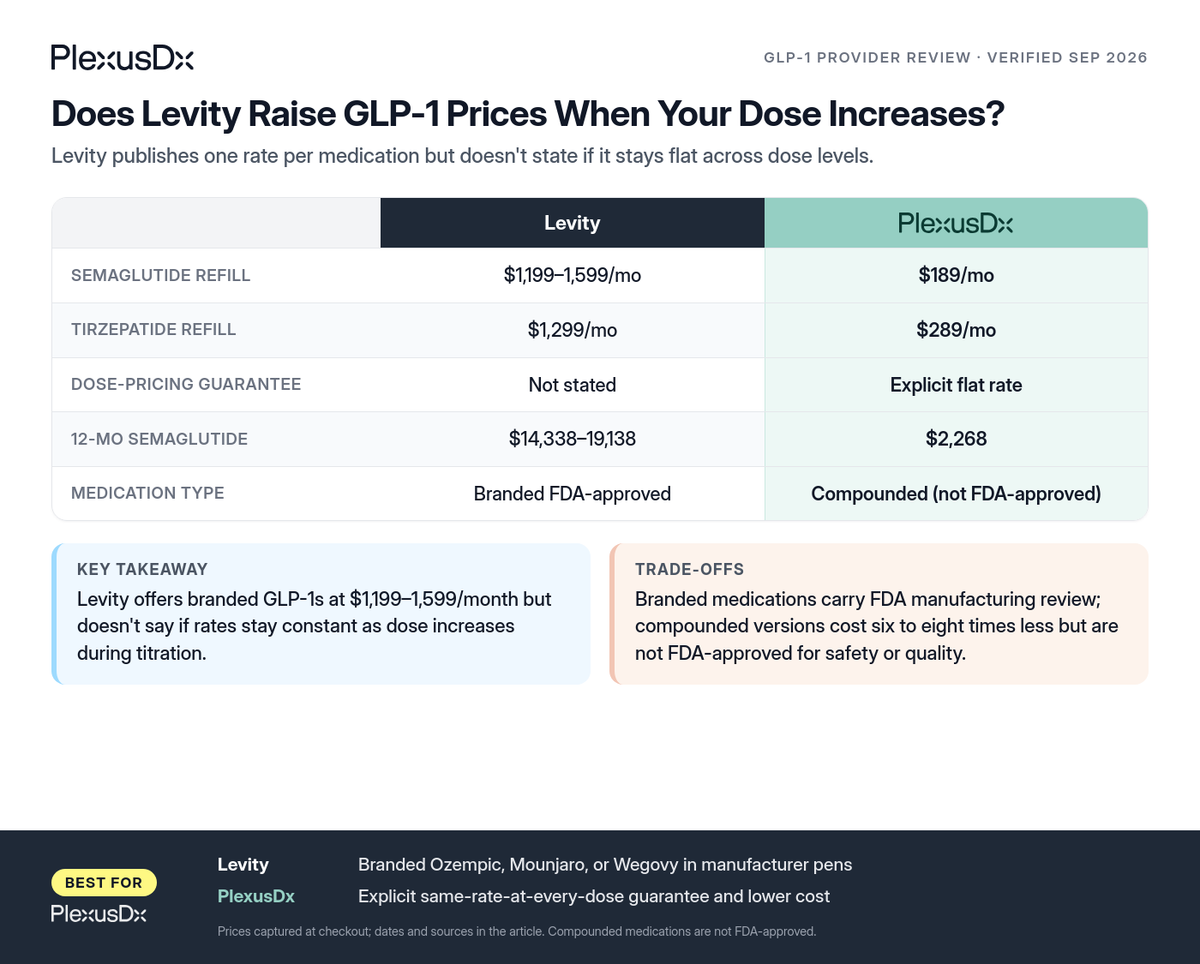
Does Levity Raise GLP-1 Prices When Your Dose Increases? — 2026
Levity publishes monthly rates for branded GLP-1 medications but does not disclose whether those rates remain constant across all dose levels or change as your prescription increases during titration.
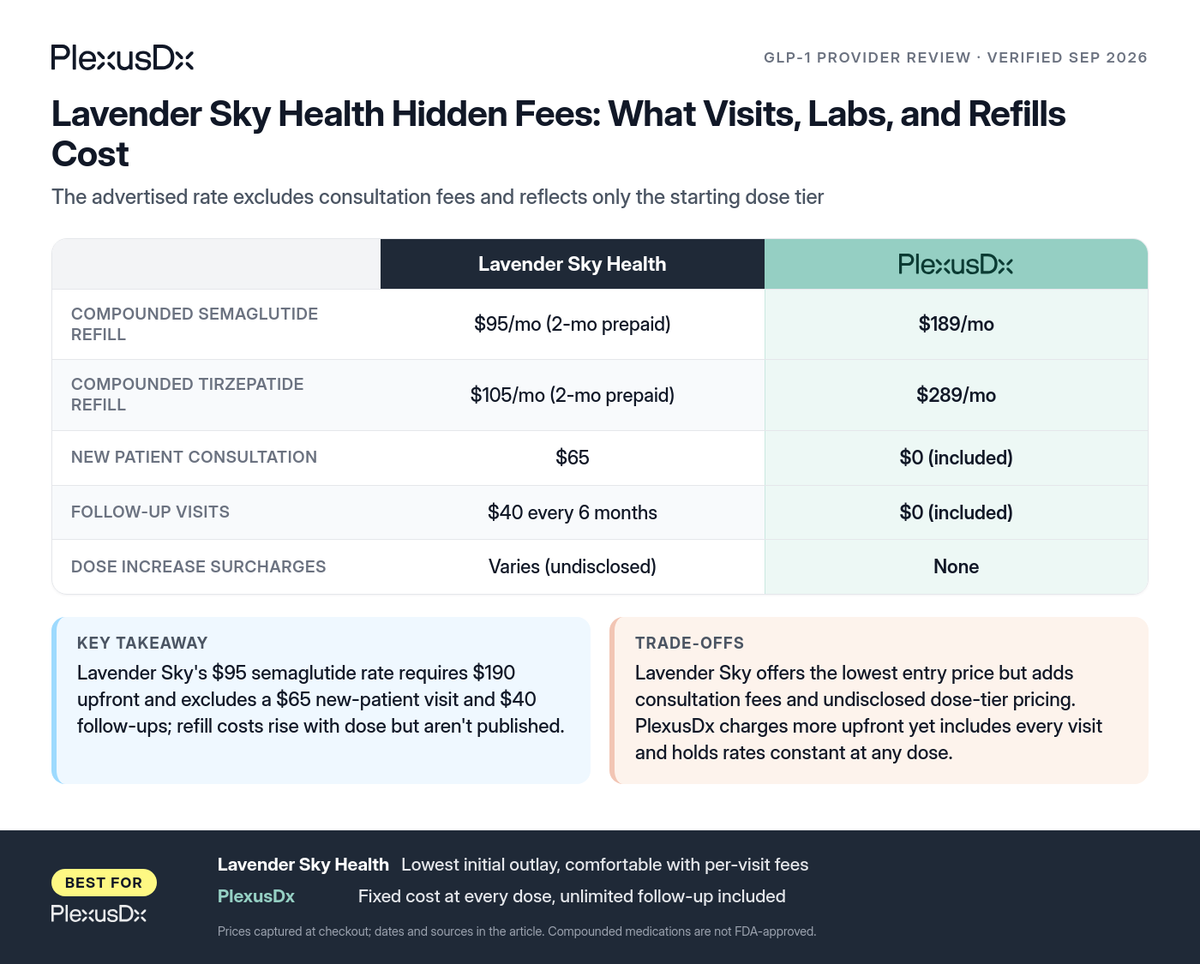
Lavender Sky Health Hidden Fees: What Visits, Labs, and Refills Cost
Lavender Sky Health advertises compounded semaglutide from a two-month prepaid equivalent of $95/month, but consultation fees, dose increases, and brand-plan charges add layers many shoppers discover only at checkout.
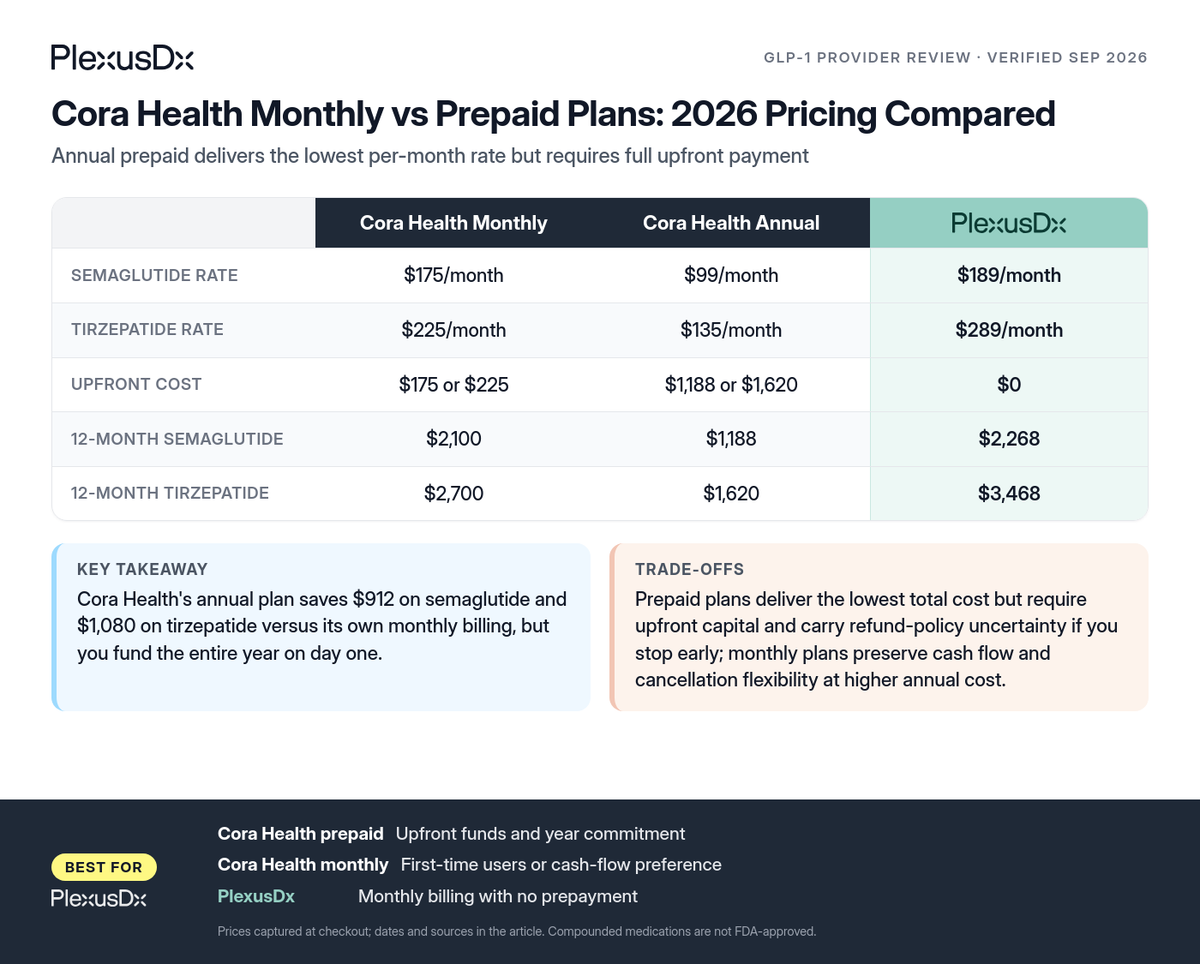
Cora Health Monthly vs Prepaid Plans: 2026 Pricing and Plans Compared
Cora Health offers four billing options for compounded semaglutide and tirzepatide, with prepaid annual plans delivering the lowest per-month rate but requiring full upfront payment. We break down the 12-month math for each option and show where PlexusDx fits.
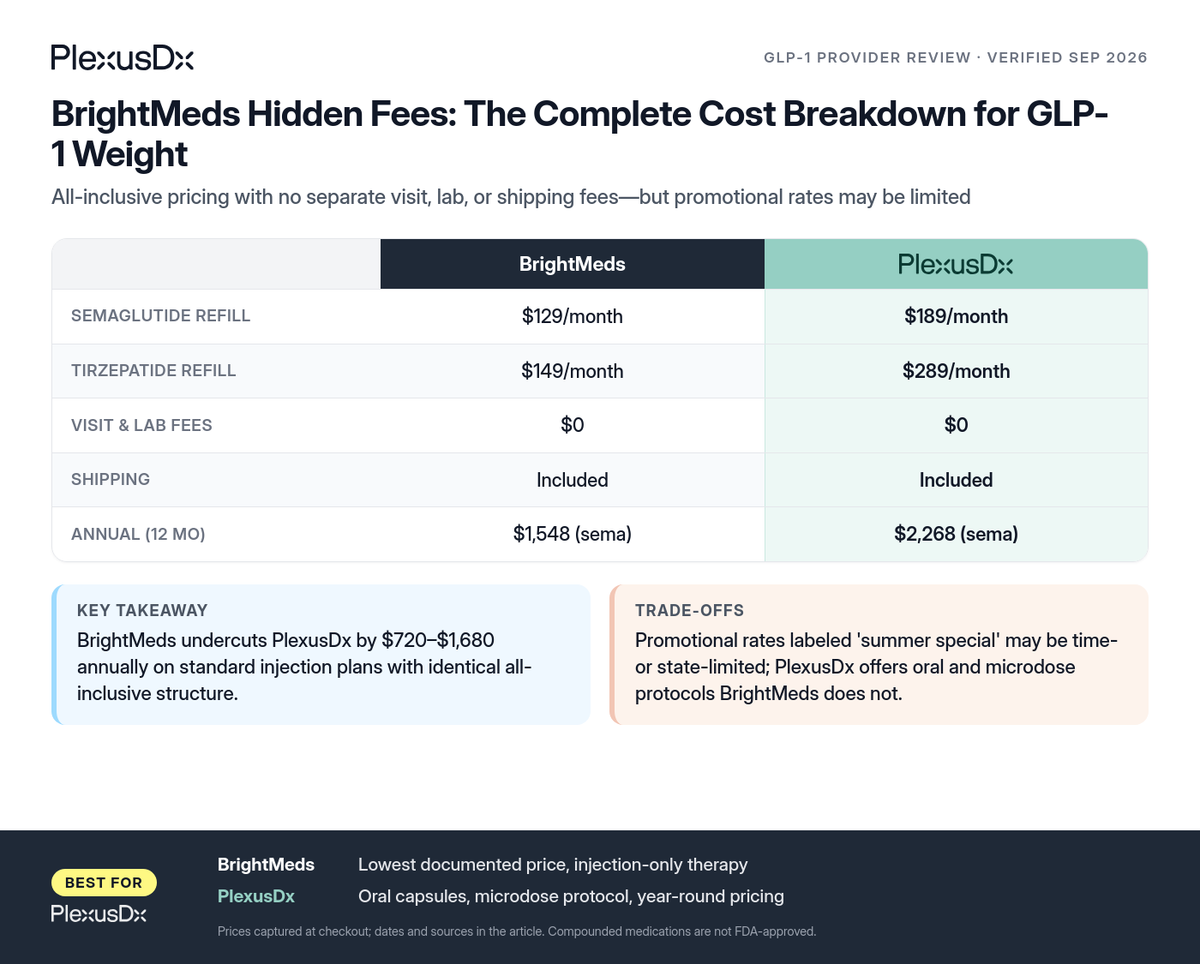
BrightMeds Hidden Fees: The Complete Cost Breakdown for GLP-1 Weight
BrightMeds advertises $129 monthly semaglutide with no membership or lab fees. We document every included service, compare prepaid and month-to-month plans, and calculate 12-month costs against PlexusDx transparent pricing.
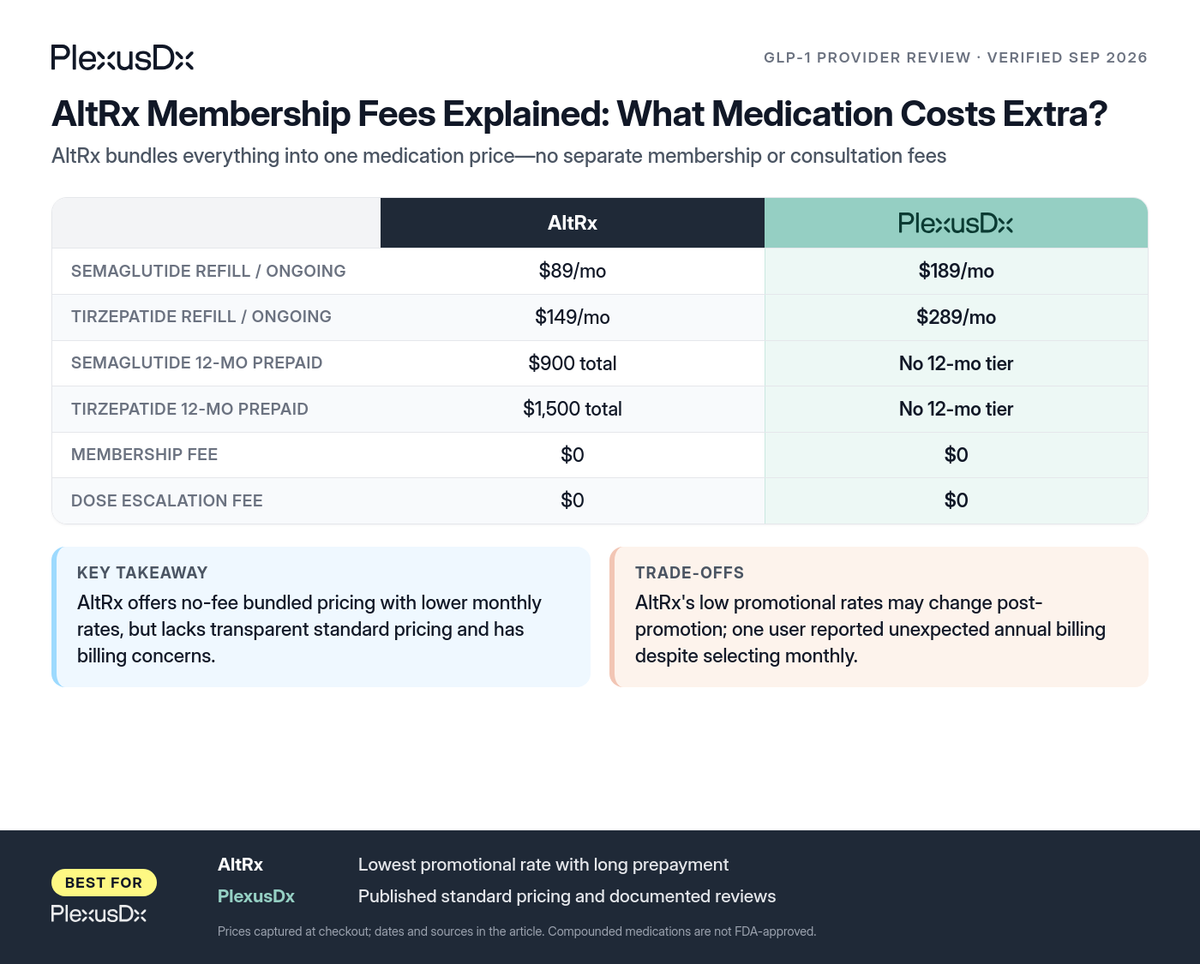
AltRx Membership Fees Explained: What Medication Costs Extra?
AltRx charges no separate membership fee; all costs—medication, provider visit, support, and shipping—are bundled into a single monthly or prepaid medication price starting at $89/month for semaglutide under a promotional offer captured September 2026.
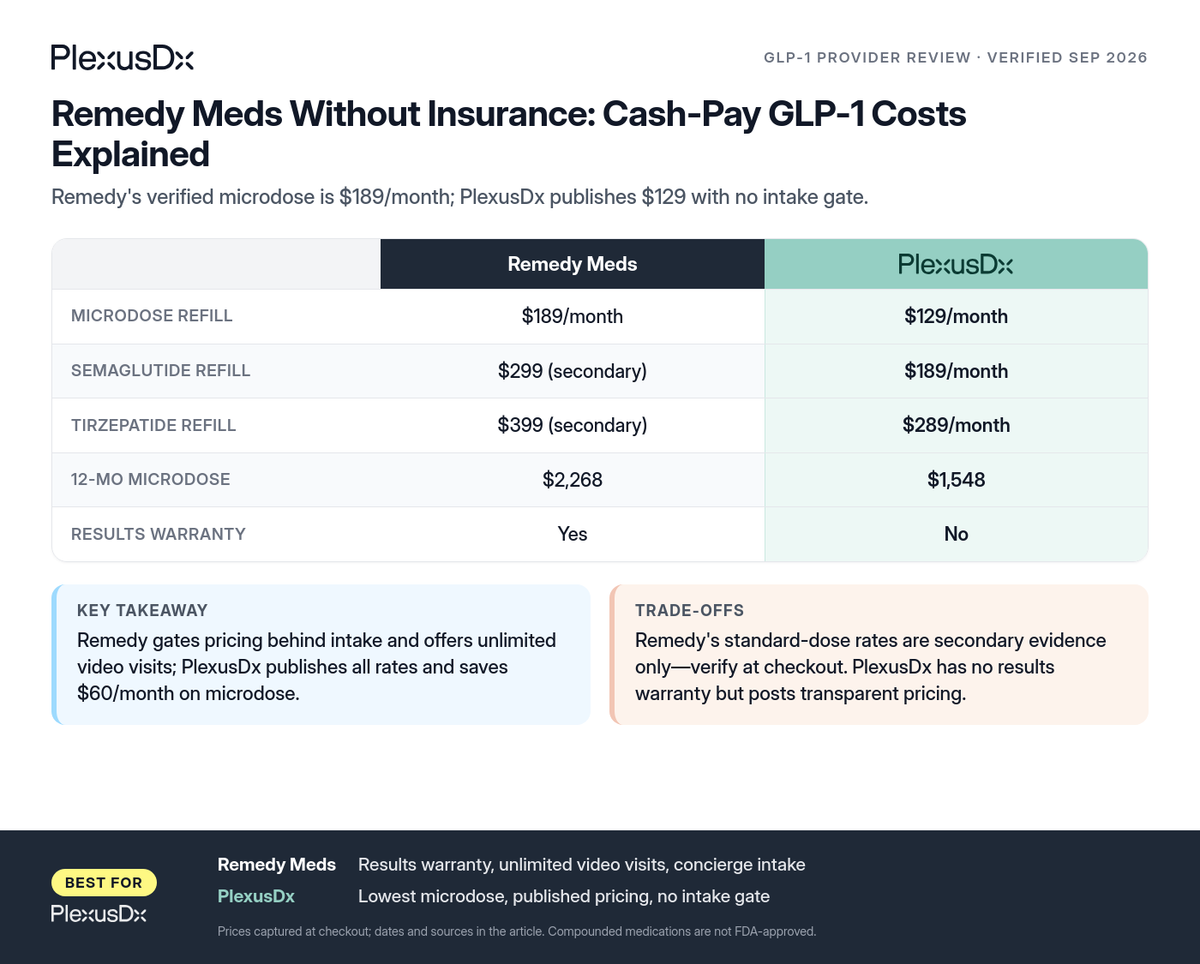
Remedy Meds Without Insurance: Cash-Pay GLP-1 Costs Explained
Remedy Meds shows no prices publicly; figures appear only after intake. The verified cash-pay microdose plan costs $189/month. Standard-dose pricing is secondary evidence and must be confirmed at checkout.
Noom Med vs Low-Cost GLP-1 Providers: Price and Service Compared
Noom Med's microdose program offers a first-month rate and ongoing refill rate that average less per month over 12 months than most competitors.
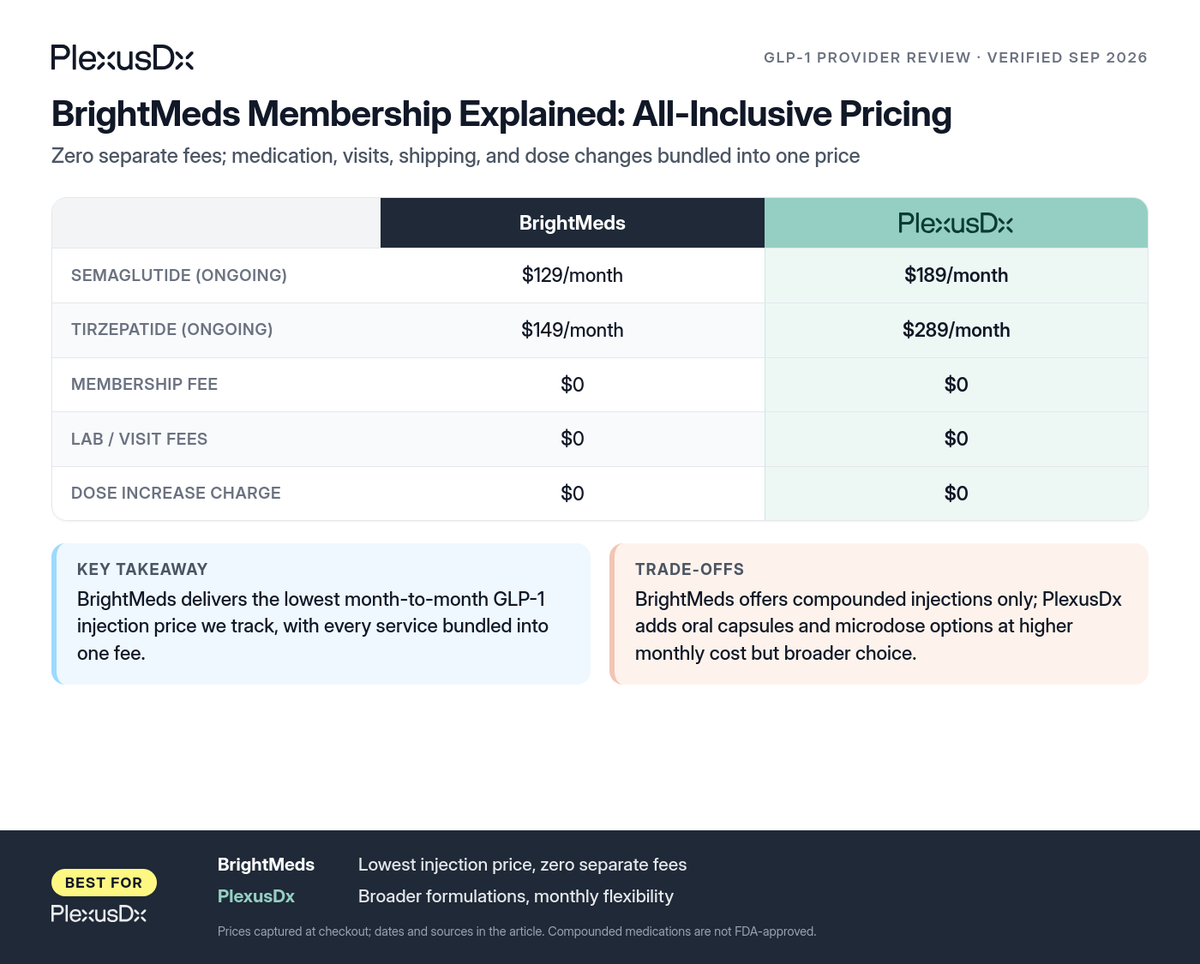
BrightMeds Membership Explained: All-Inclusive Pricing, No Hidden Fees
BrightMeds charges no membership fee, no lab fee, and no prescribing fee. Medication, visits, and shipping are bundled into a single monthly price for semaglutide or tirzepatide injections.
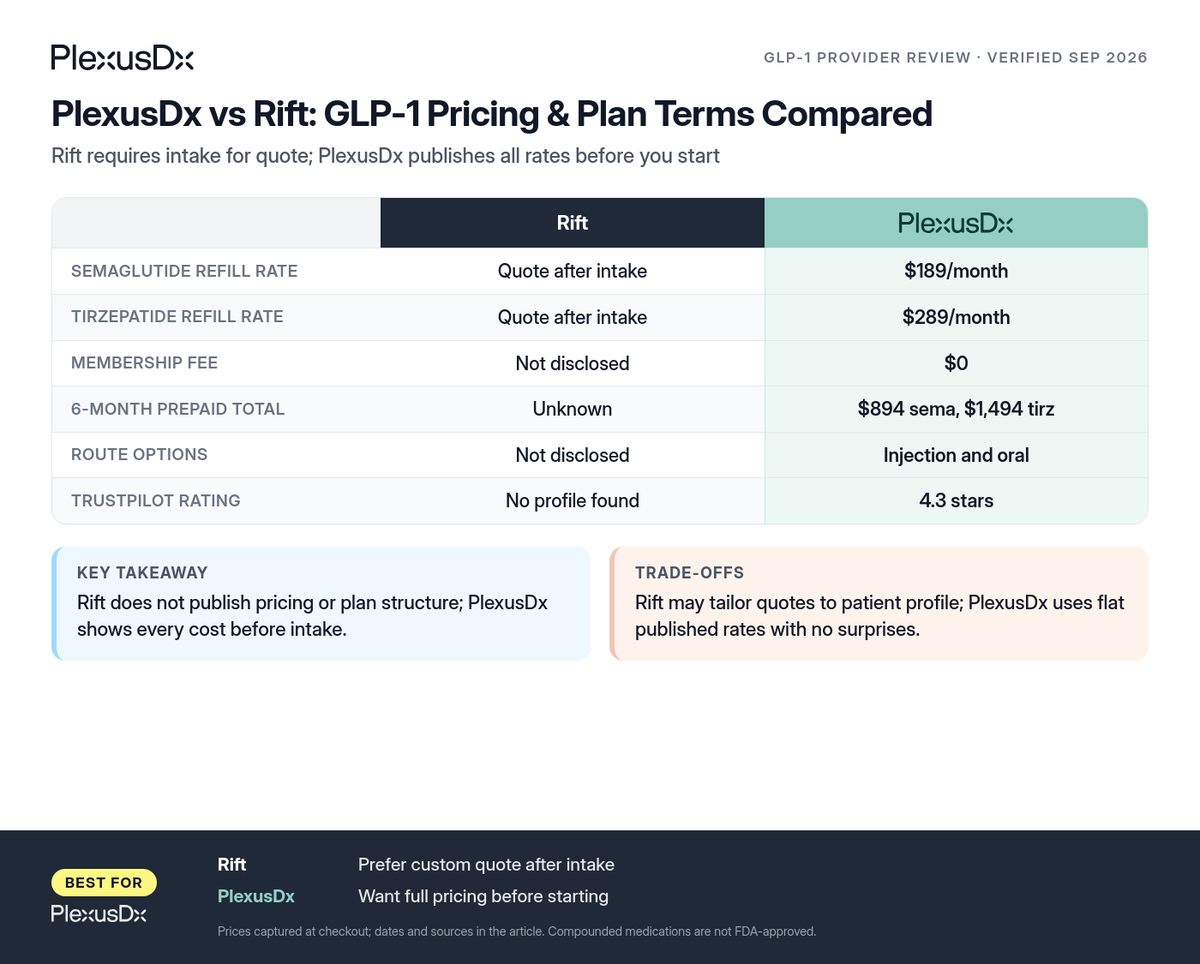
PlexusDx vs Rift: GLP-1 Pricing & Plan Terms Compared in 2026
Rift does not publish pricing or plan details on its public website; a quote is issued after questionnaire completion. PlexusDx lists month-to-month rates at $189 for semaglutide and $289 for tirzepatide, with no membership fee and prepaid multi-month discounts available.
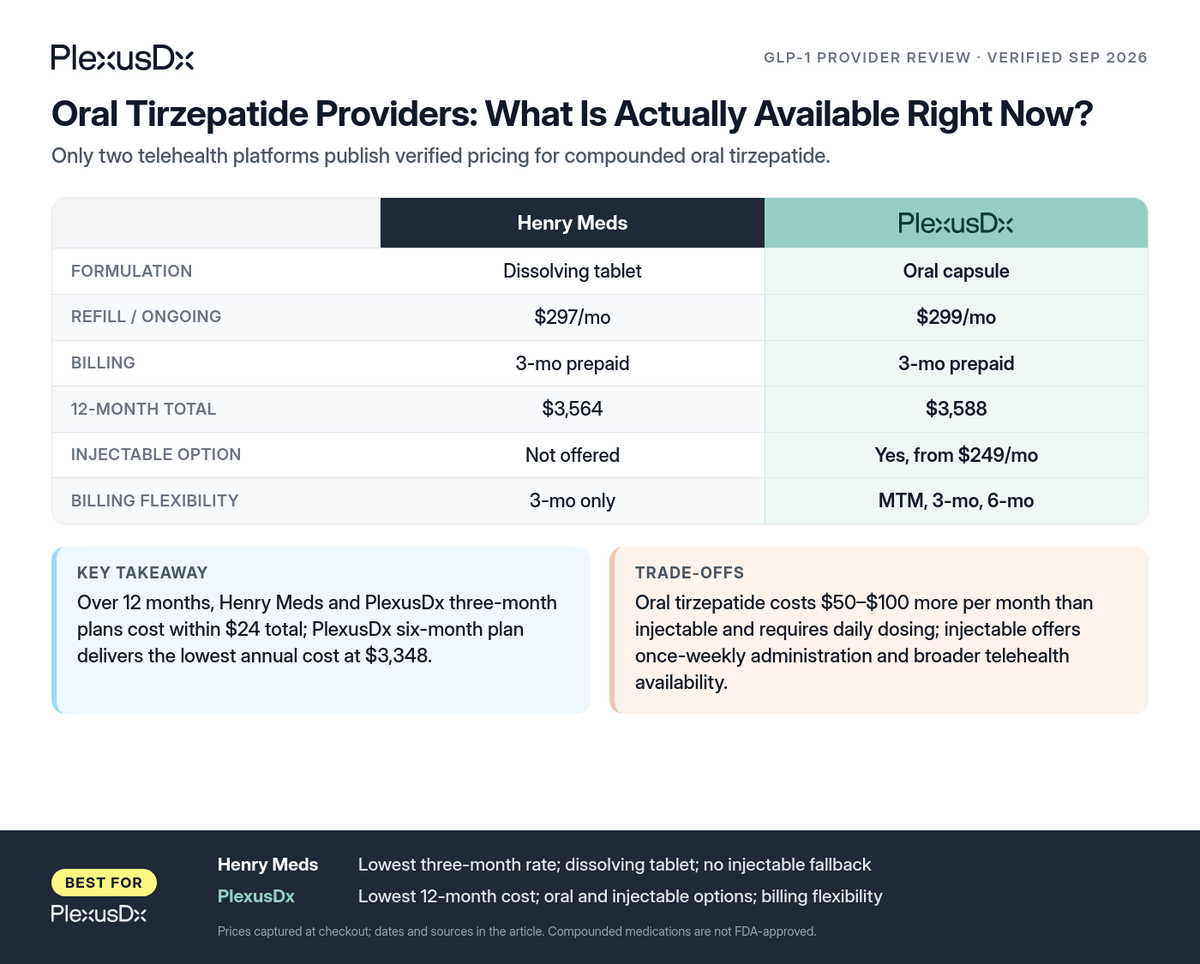
Oral Tirzepatide Providers: What Is Actually Available Right Now?
Very few telehealth weight-management platforms currently offer compounded tirzepatide in oral form, and pricing evidence is fragmented. We verified every published price and route option across 30+ providers.
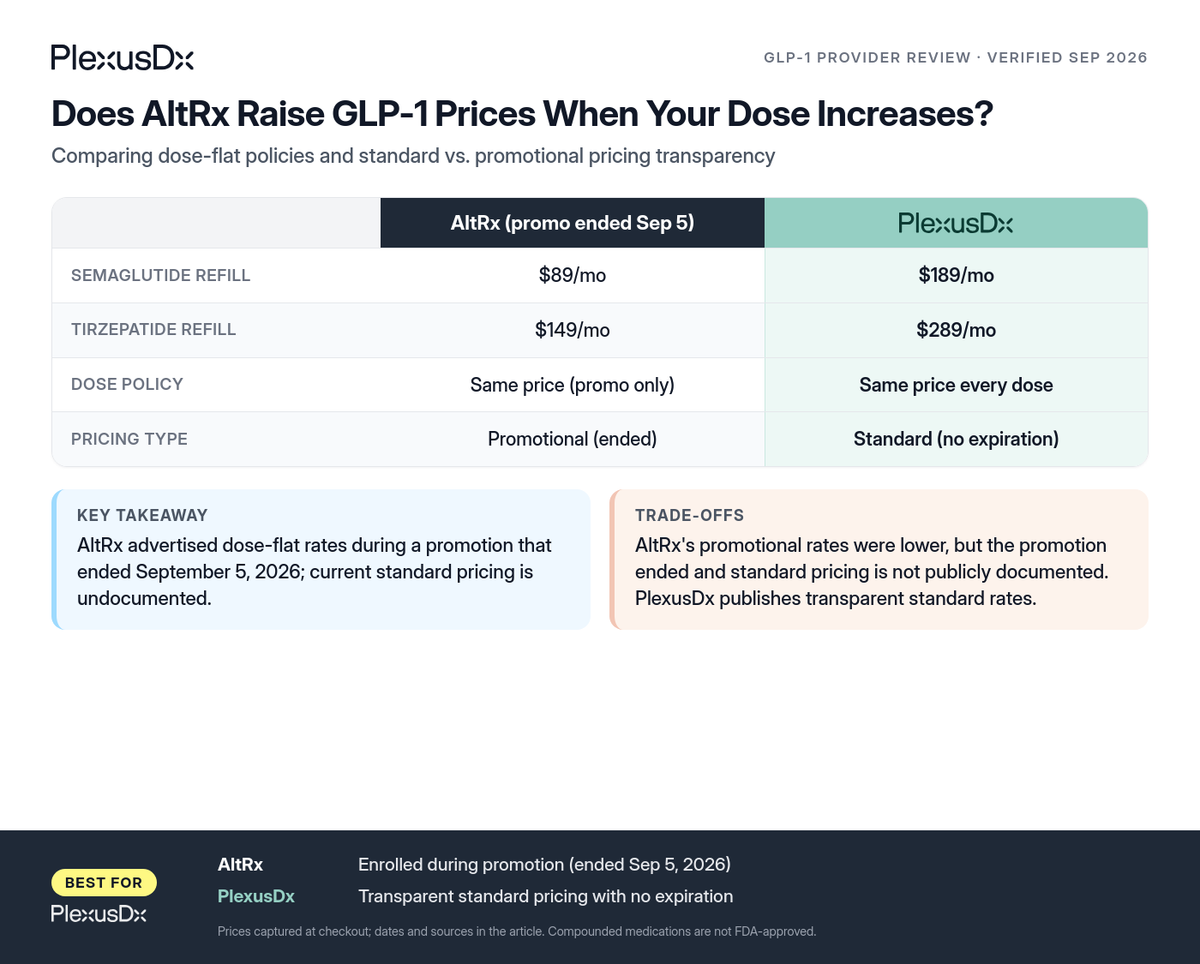
Does AltRx Raise GLP-1 Prices When Your Dose Increases? — 2026
AltRx's promotional pricing grid explicitly states "same price at all doses" for both semaglutide and tirzepatide, but the offer ended September 5, 2026, and post-promotion pricing is undocumented.
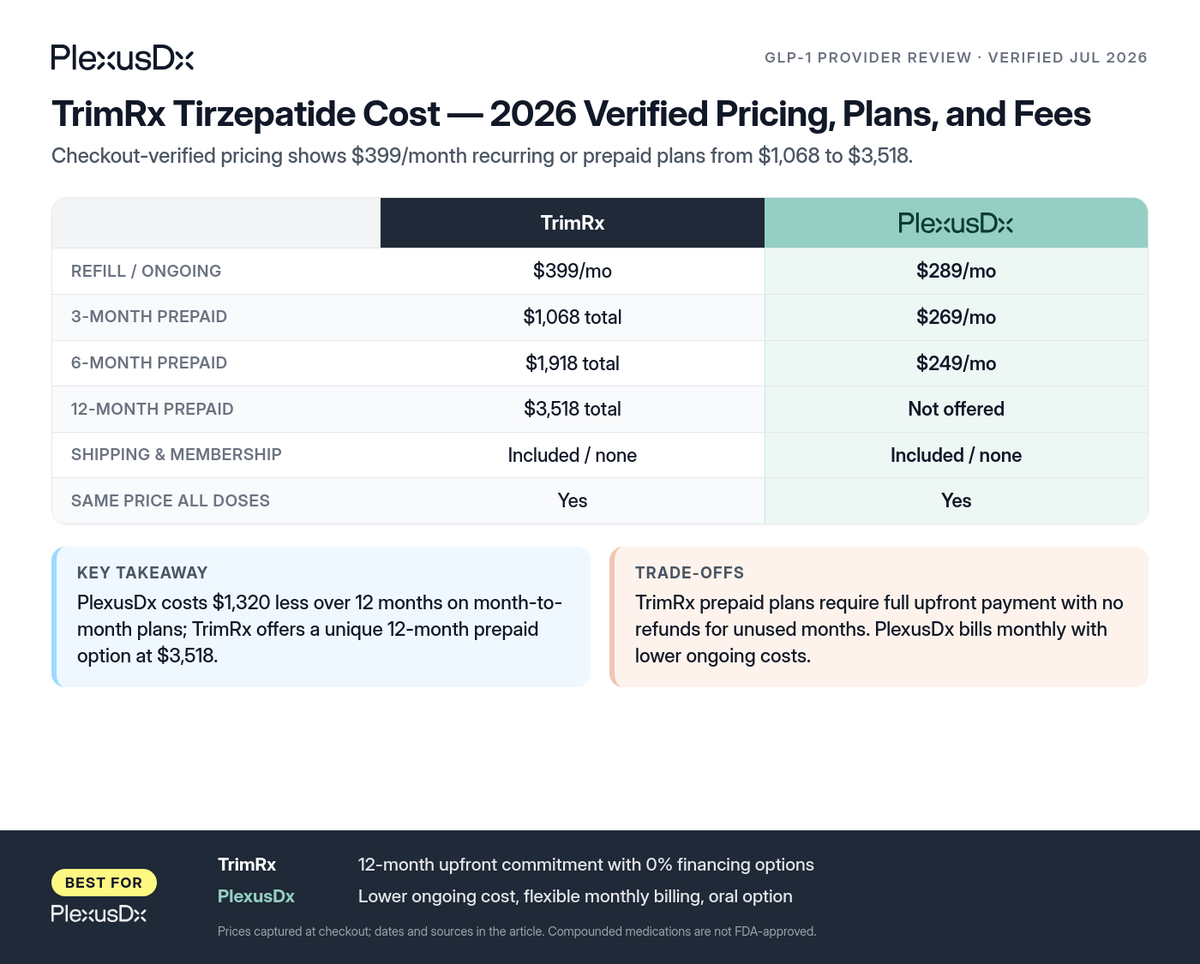
TrimRx Tirzepatide Cost — 2026 Verified Pricing, Plans, and Fees
TrimRx advertises tirzepatide at $349/month, but checkout-verified pricing shows $399 month-to-month and prepaid plans from $1,068 for three months to $3,518 for twelve. We compare billing structure, dose pricing, and total cost over twelve months.
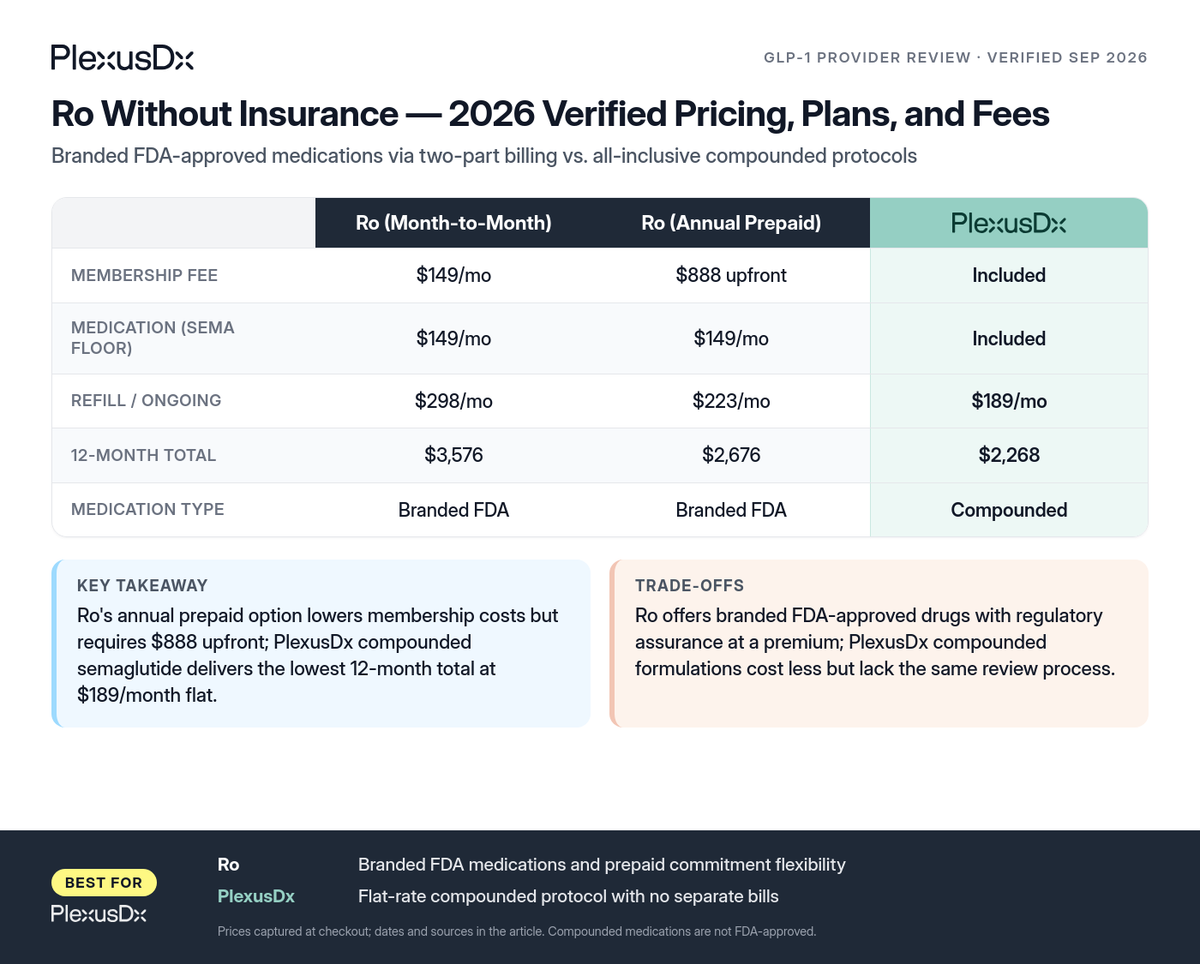
Ro Without Insurance — 2026 Verified Pricing, Plans, and Fees
Ro charges separately for membership ($149/month) and branded medication ($149–$449/month, dose-dependent). Month-to-month semaglutide totals $298/month; prepaid membership plans lower the membership portion but medication remains the same.
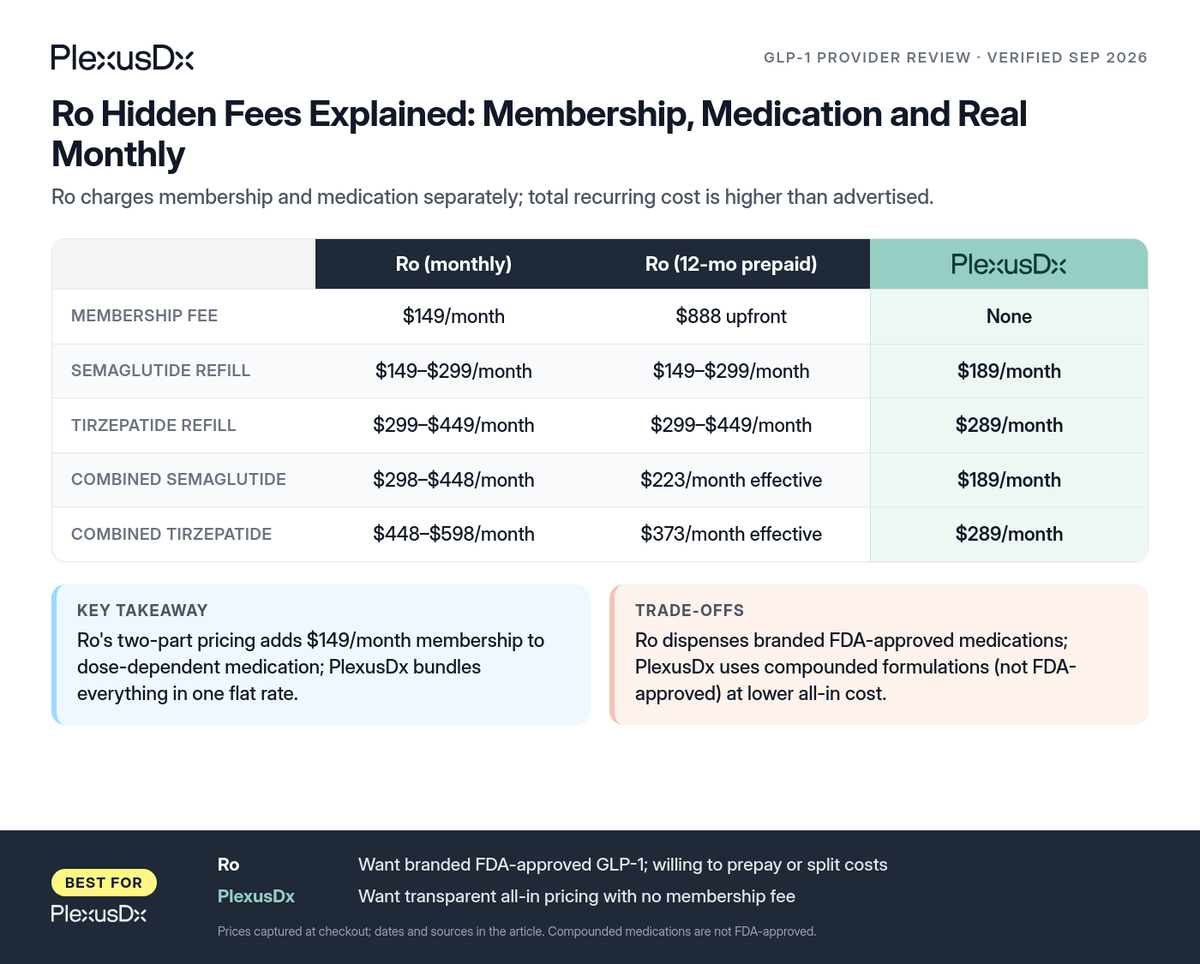
Ro Hidden Fees Explained: Membership, Medication and Real Monthly
Ro's weight-management program separates membership from medication costs. We break down the Body Program fees, dose-dependent medication charges, and what Ro does not itemize—shipping, labs, and detailed visit costs—so you see the true recurring expense.
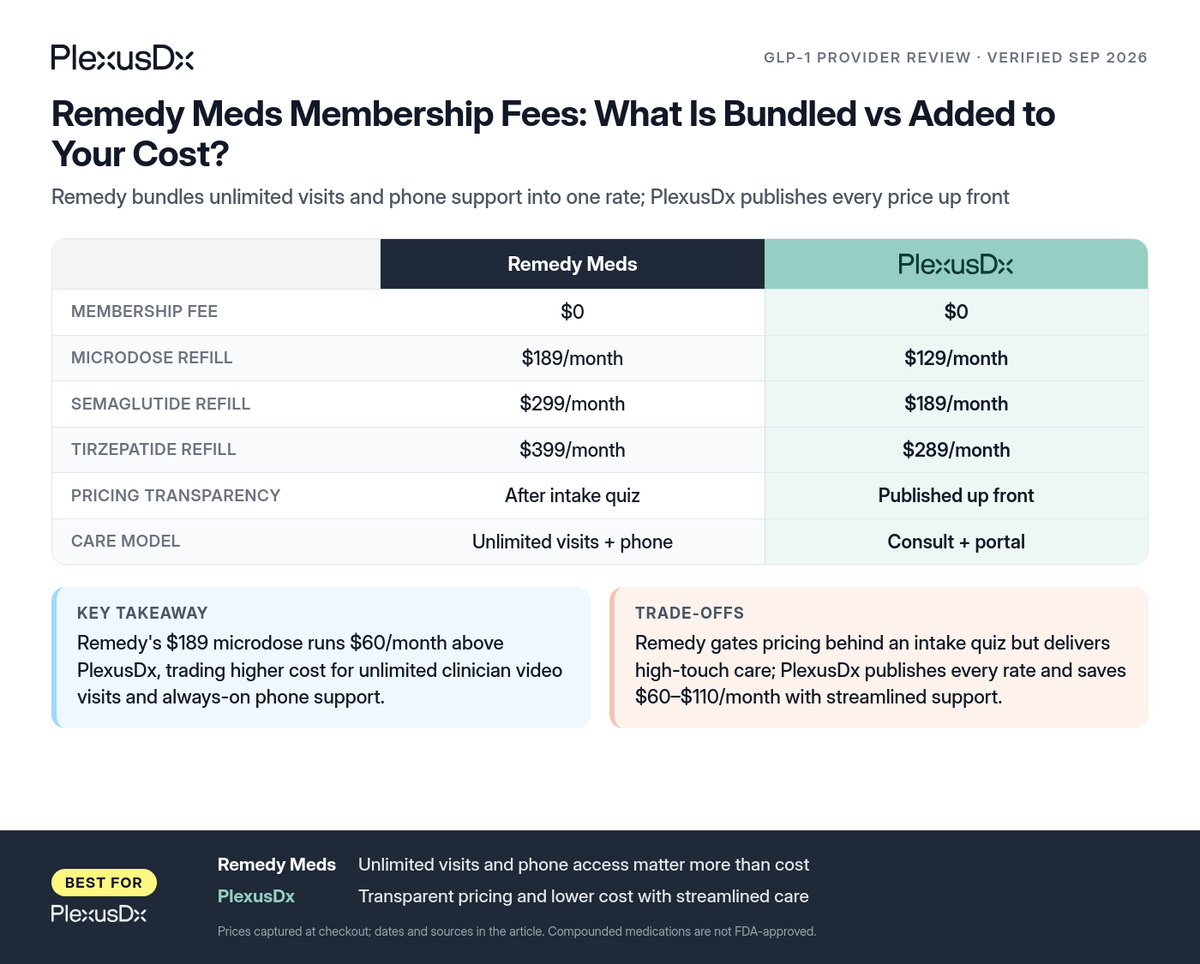
Remedy Meds Membership Fees: What Is Bundled vs Added to Your Cost?
Remedy Meds charges no membership fee; medication, unlimited provider visits, phone support, and shipping are bundled into a single monthly price shown after intake. Only the microdose plan price ($189/month) is publicly documented.
LifeMD Hidden Fees: Membership, Visits, Labs, and Medication Costs
LifeMD's advertised membership covers visits, coaching, and labs—but medication is billed separately, adding $149 to $299 or more per month. Here's how the monthly fees stack and what you'll actually pay over 12 months.
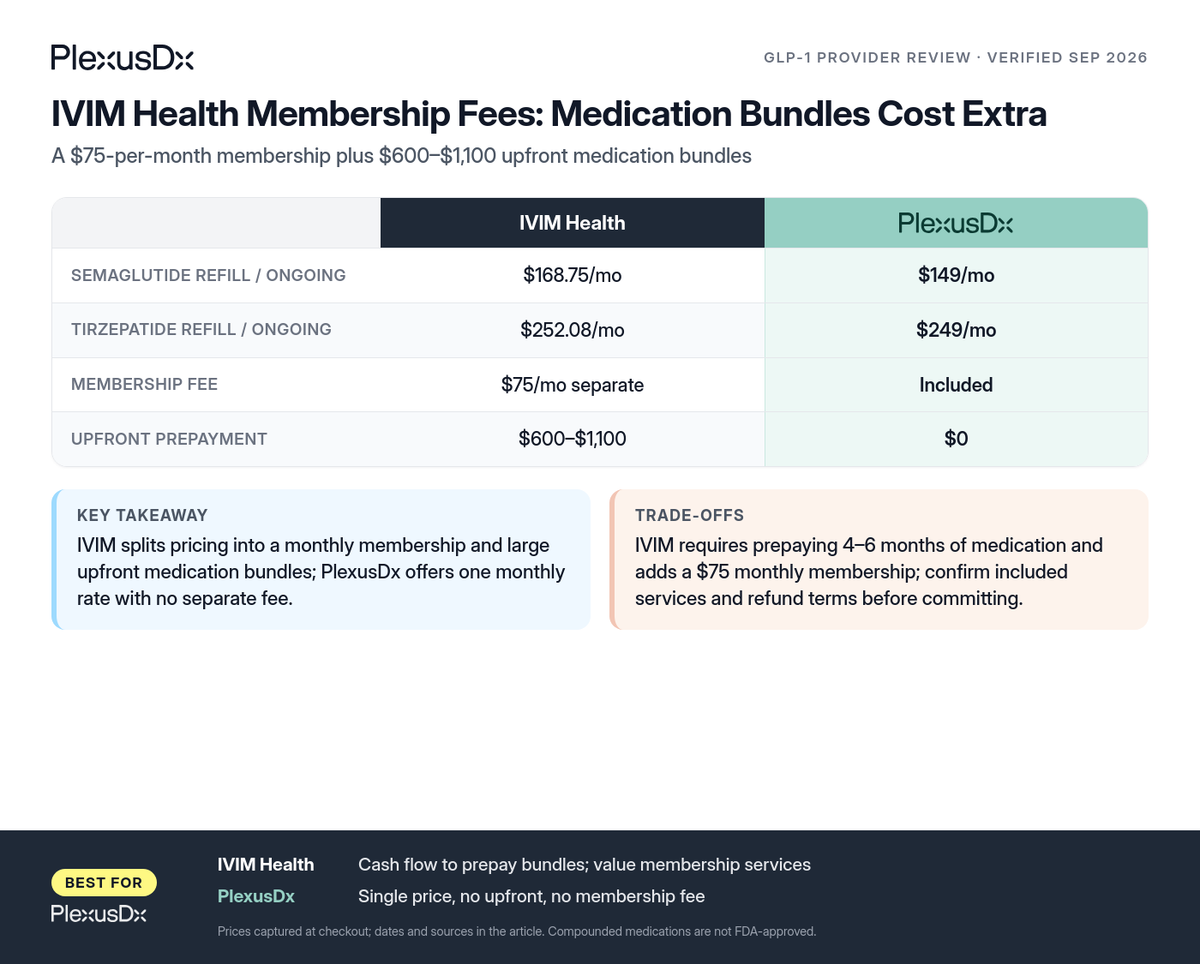
IVIM Health Membership Fees: Medication Bundles Cost Extra in 2026
IVIM Health charges a $75 monthly membership fee on top of prepaid medication bundles. Semaglutide costs $600 for six months, tirzepatide $1,100, both paid upfront, with membership billed separately.
Form Health Hidden Fees: What the $299/Month Rate Excludes in 2026
Form Health charges $299/month for physician and dietitian access, but that rate excludes medication and lab costs—the two largest expenses in weight-loss treatment. We break down the fee structure and compare it with all-inclusive alternatives.

First Month on Microdose Tirzepatide: What 57 Patients Reported
What is the average weight loss on tirzepatide in the first month at a microdose? The PlexusDx study reports what 57 patients recorded 14 to 35 days after starting 1 to 2 mg a week, including how many lost nothing. Here is the full picture, with its limits.
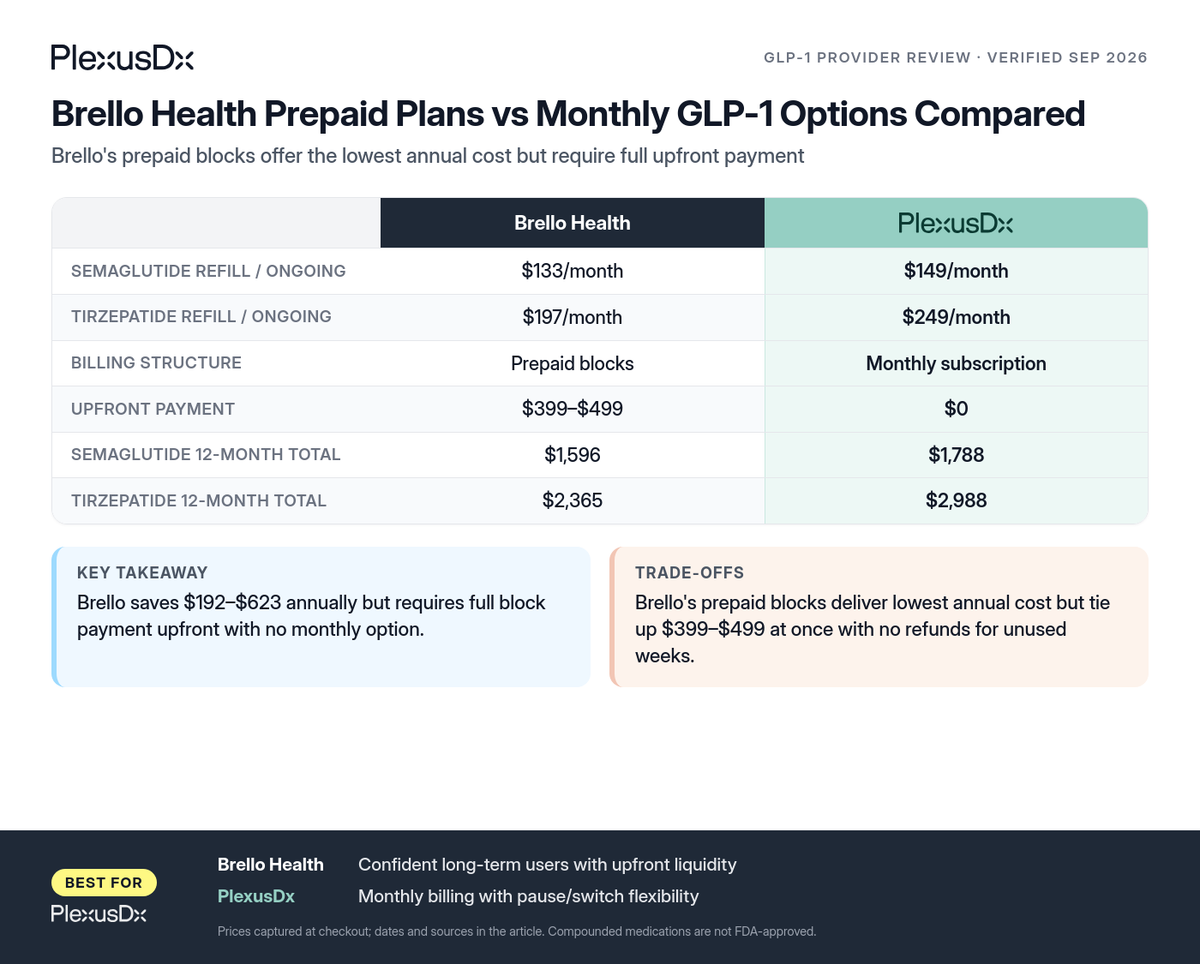
Brello Health Prepaid Plans vs Monthly GLP-1 Options Compared
Brello Health requires upfront payment for three-month or eleven-week blocks. We compare the effective monthly cost of Brello's prepaid structure against true month-to-month and subscription options.
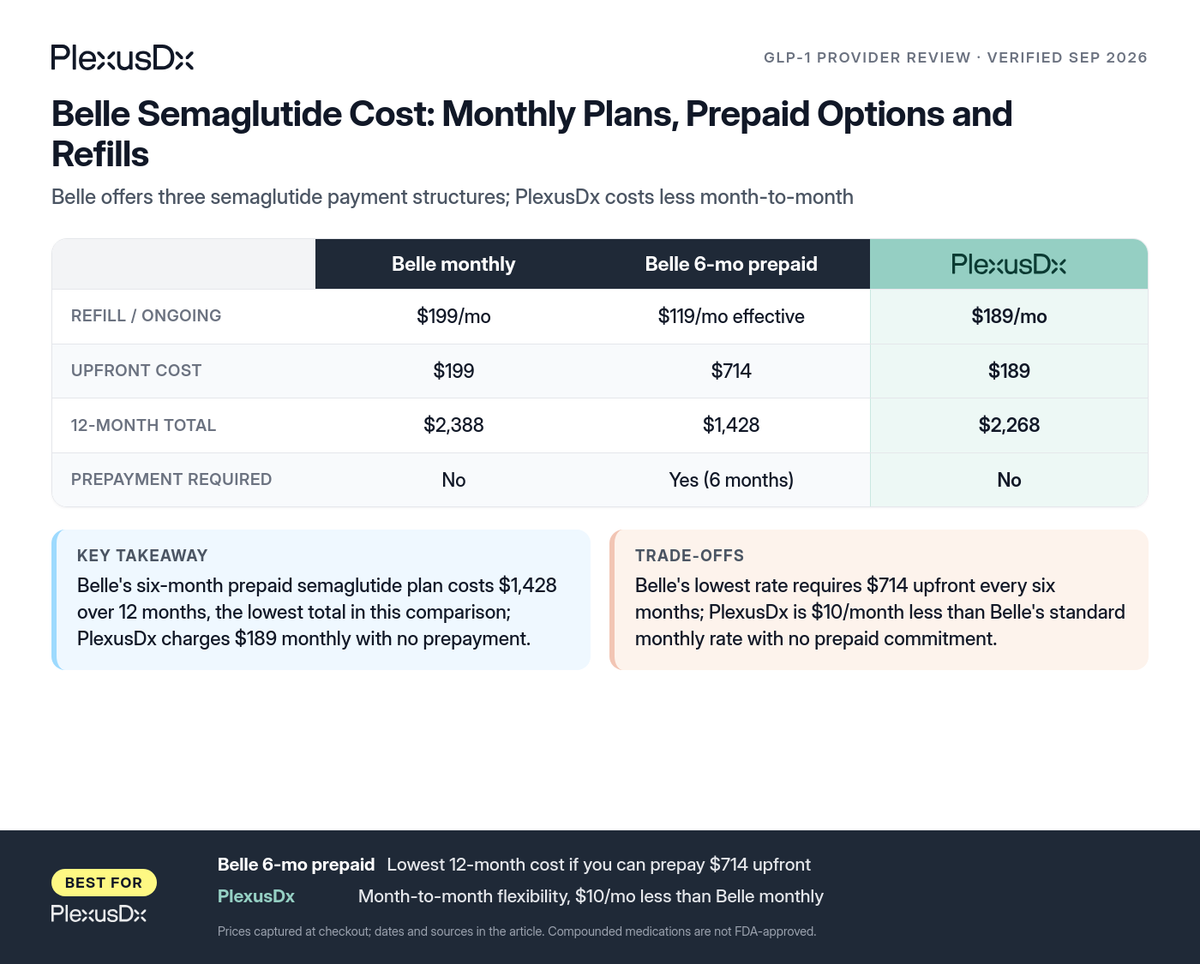
Belle Semaglutide Cost: Monthly Plans, Prepaid Options and Refills
Belle charges $199 per month for compounded semaglutide on a month-to-month plan, or $119 per month effective when six months are prepaid. This breakdown deconstructs plans, upfront costs, and 12-month totals.
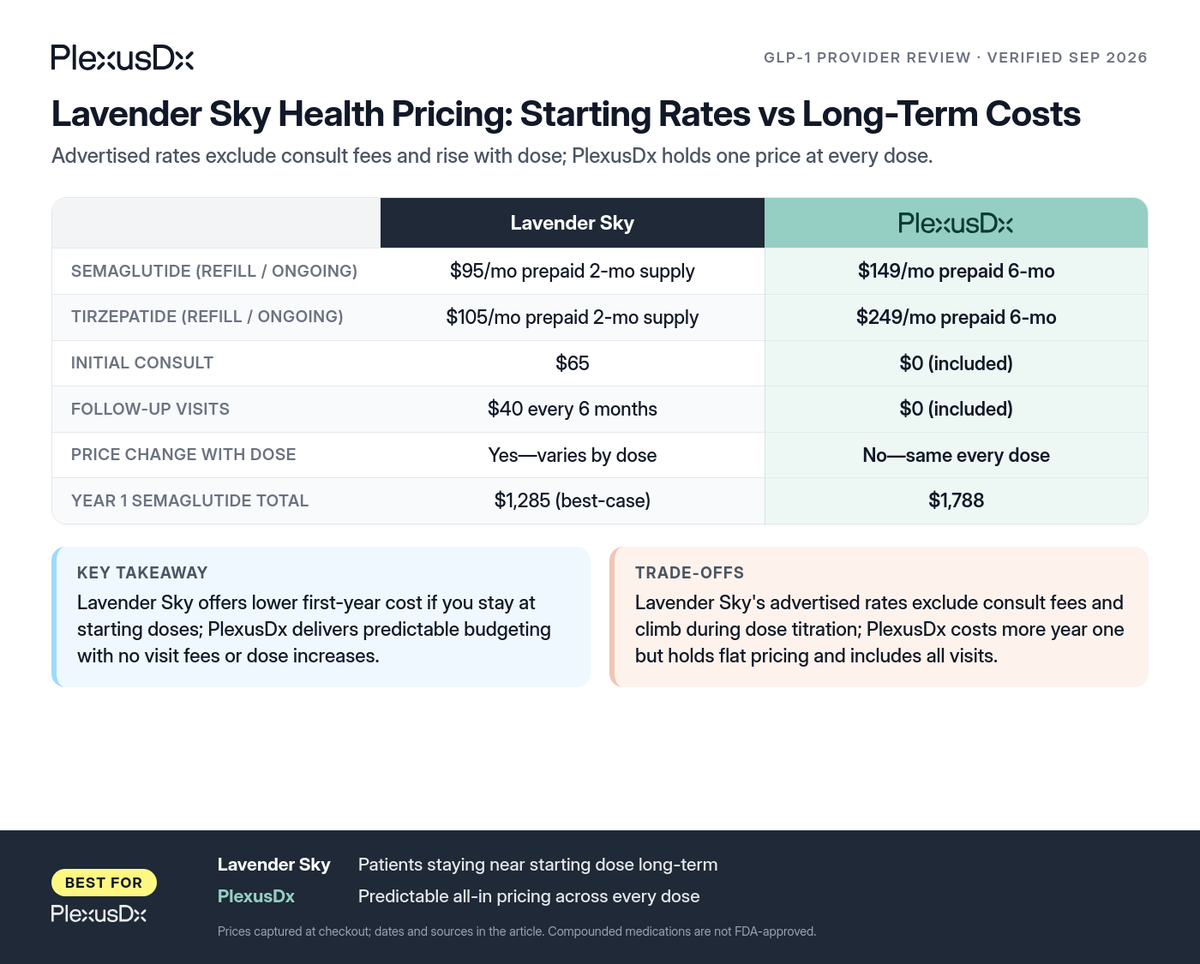
Lavender Sky Health Pricing: Starting Rates vs Long-Term Medication
Lavender Sky Health advertises compounded semaglutide at $95/month and tirzepatide at $105/month. Those figures are prepaid 2-month starting rates before consult fees; actual long-term costs depend on dose progression and recurring visits.
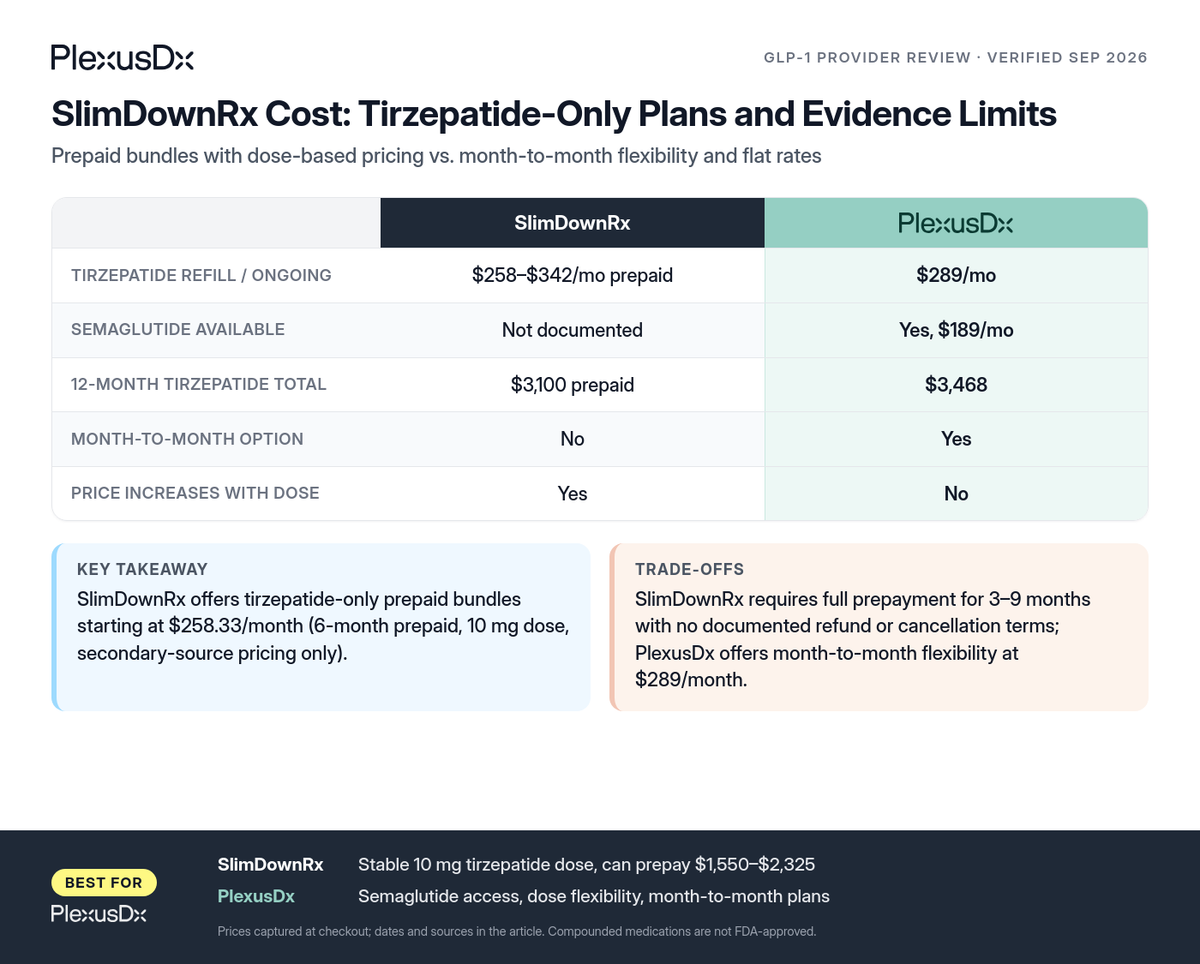
SlimDownRx Cost: Tirzepatide-Only Plans and Evidence Limitations
SlimDownRx offers compounded tirzepatide injection bundles only—no semaglutide product has been documented. Available pricing is secondary-source and requires full prepayment for multi-month periods.
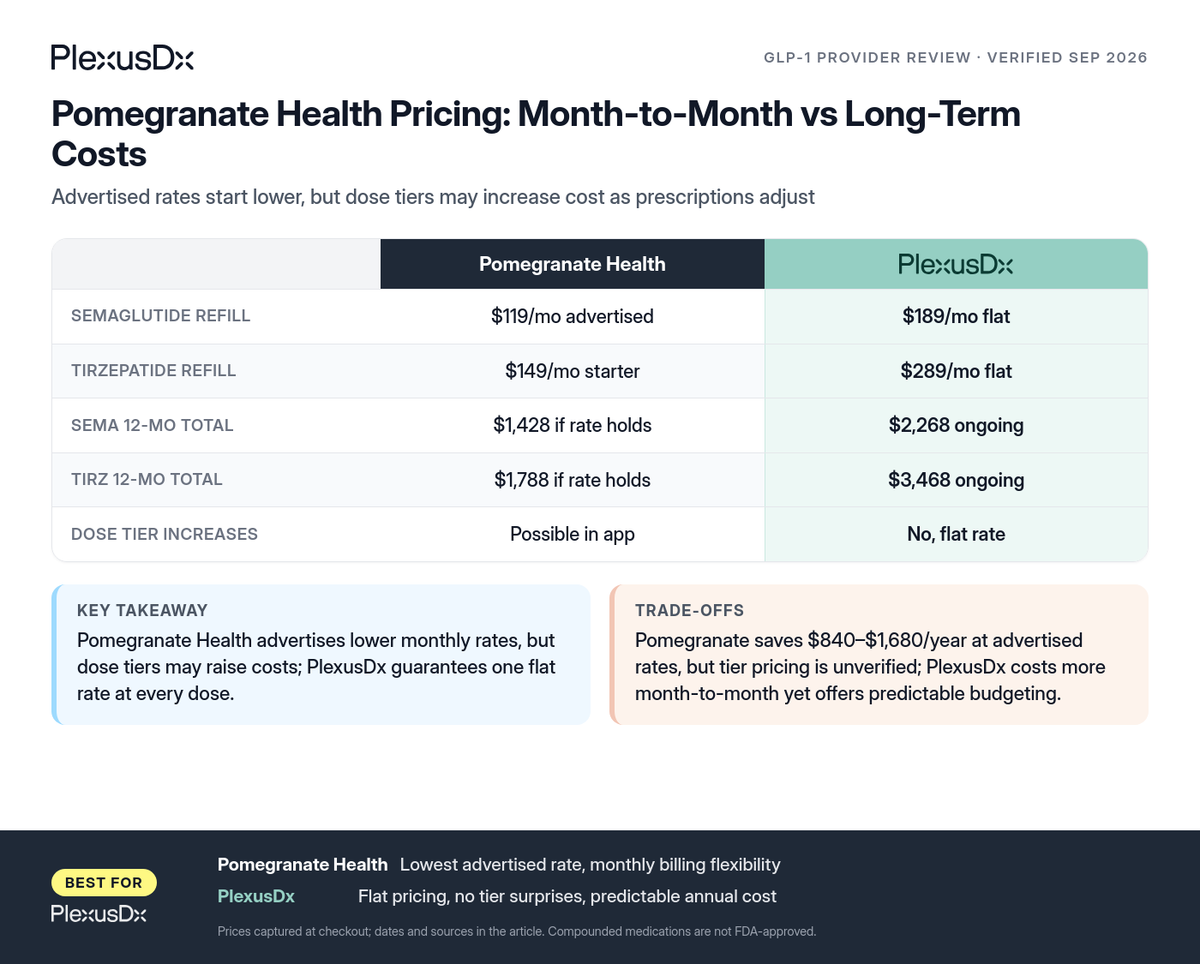
Pomegranate Health Pricing: Month-to-Month Rates vs Long-Term Costs
Pomegranate Health advertises $119/month for compounded semaglutide and $149/month for tirzepatide, but dose-tier pricing and checkout variables make long-term cost projections uncertain. We compare the advertised rates to PlexusDx's flat-at-every-dose structure and show the 12-month math.
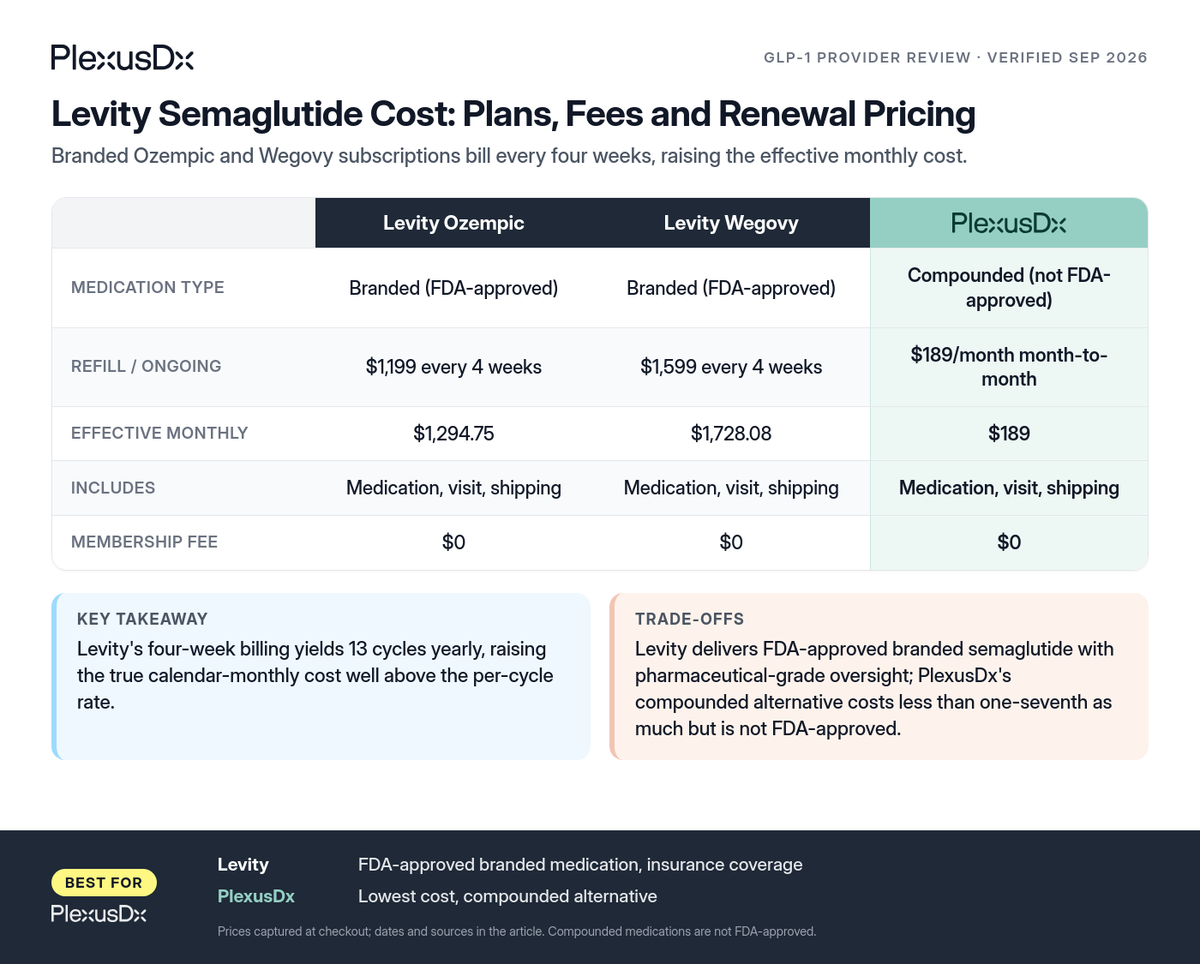
Levity Semaglutide Cost: Plans, Fees and Renewal Pricing Explained
Levity charges $1,199 every four weeks for branded Ozempic and $1,599 for Wegovy after a first-month offer. Both prices include medication, consultation, care, and shipping, with no separate membership fee.
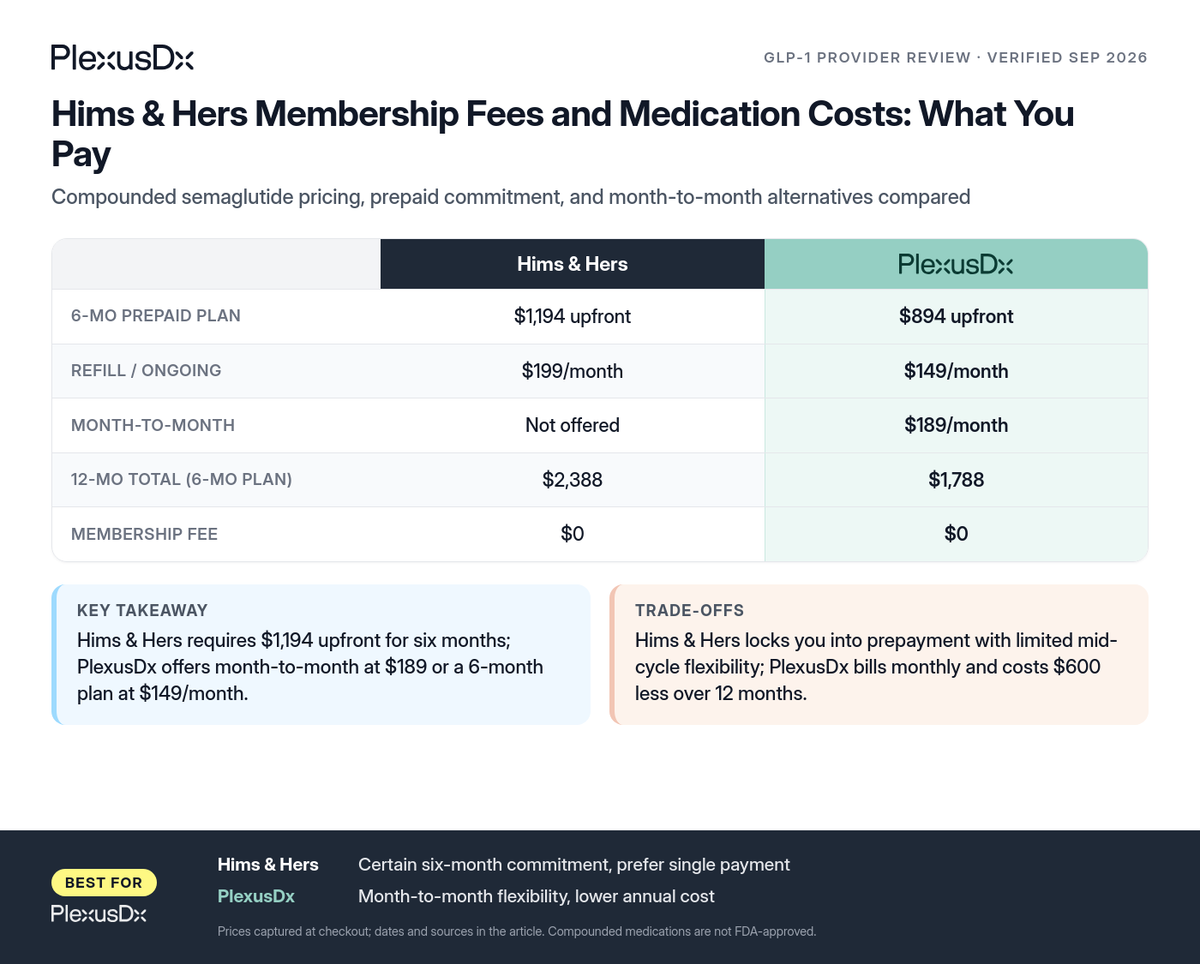
Hims & Hers Membership Fees and Medication Costs: What You Pay
Hims & Hers charges no separate monthly membership fee for its weight-management program, but medication requires a 6-month prepaid commitment at $1,194 upfront for compounded semaglutide. We break down what's included, what costs extra, and how that model compares to month-to-month pricing.
Best Alternatives to Rift for GLP-1 Treatment: 2026 Pricing Compared
Rift does not publish itemized GLP-1 pricing or plan details. We compare seven verified alternatives—PlexusDx, Eden, Embody, Found, Henry Meds, Peak Wellness, and TrimRx—with checkout-confirmed rates, billing structures, and 12-month cost calculations.
