Last reviewed: September 19, 2026
Last updated: September 19, 2026
Written by: Jay Hastings, CEO of PlexusDx
Jay Hastings is the CEO of PlexusDx, a precision health company focused on genetic testing, blood biomarker insights, and personalized wellness recommendations. He has more than 20 years of experience across healthcare innovation, genomics, laboratory operations, healthcare investing, and strategic finance. His work has included scaling healthcare startups, leading CLIA lab integrations, and helping expand consumer access to precision health tools.
Medically reviewed by: Jayden Lee, PharmD, EMBA
Jayden Lee, PharmD, EMBA, is the PlexusDx Medical Science Liaison with a PharmD and MBA specializing in pharmacogenomics and clinical product development, with a proven ability to bridge the gap between genomic research and practical patient outcomes. Dr. Lee has more than 10 years of professional experience in clinical pharmacy, academia, and research.
PlexusDx publishes this comparison and is one of the providers discussed. We use the same evidence rules for our own program and competing programs.
The short answer
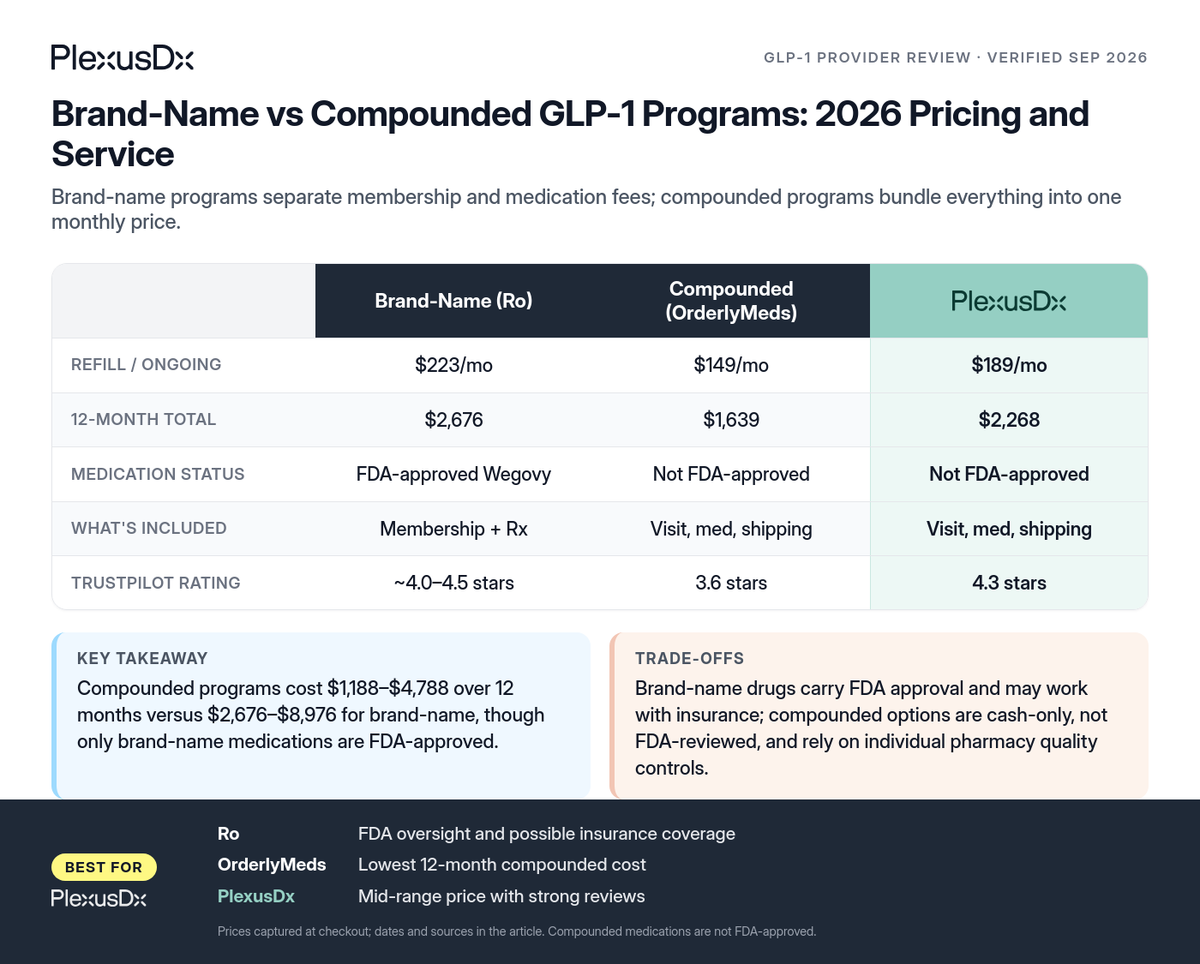
Brand-name GLP-1 telehealth programs—offering FDA-approved Wegovy and Zepbound through prescriptions filled at retail pharmacies—typically separate membership fees ($74–$299/month) from medication costs ($149–$449/month), creating all-in monthly bills of $223–$748 depending on dose and membership tier. Compounded GLP-1 programs bundle provider visits, compounded medication, and shipping into a single monthly price, most often $99–$299 per month for semaglutide and $199–$399 for tirzepatide. Over 12 months a brand-name program can cost $2,676–$8,976 while a compounded program typically runs $1,188–$3,588 for the same active ingredient, though compounded medications are not FDA-approved and brand-name drugs carry the regulatory review, manufacturing oversight, and labeling guarantees that compounded preparations do not. Service quality—measured by review ratings, response times, and refill consistency—varies within each camp more than between them; several compounded-only providers hold Trustpilot ratings equal to or higher than the leading brand-name platforms, while others report significant fulfillment and support complaints.
Brand-name vs compounded GLP-1 at a glance
| Dimension |
Brand-Name Programs |
Compounded Programs |
| Regulatory status |
FDA-approved medications (Wegovy, Zepbound, Ozempic, Mounjaro, Saxenda) |
Compounded semaglutide and tirzepatide; not FDA-approved |
| Typical cost structure |
Membership $74–$299/mo + medication $149–$449/mo |
All-inclusive $99–$399/mo (medication, visit, shipping) |
| 12-month all-in range |
$2,676–$8,976 (our calculation) |
$1,188–$4,788 (our calculation) |
| Dosing flexibility |
Per-dose pricing common; higher doses cost more |
Many programs charge the same price at every dose |
| Insurance interaction |
May coordinate coverage or prior authorization; copays replace self-pay medication cost when approved |
Cash-pay only; no insurance billing |
| Service model |
Prescription sent to retail or specialty pharmacy; patient may pick up or arrange delivery |
Medication shipped from 503A compounding pharmacy directly to patient |
| Review sentiment range |
Trustpilot 4.0–4.5 stars typical; complaints focus on separate billing, prior-auth delays, customer service |
Trustpilot 3.6–4.7 stars; complaints focus on fulfillment delays, pharmacy changes, response time |
Normalized 12-month all-in costs: brand-name leaders
Brand-name programs separate membership from medication. The following table presents month-to-month all-in costs and 12-month totals, reflecting the most economical published membership tier and starting-dose medication price where per-dose pricing applies. All 12-month figures are our calculation; rates were captured September 4, 2026, unless noted.
| Provider |
Membership/mo |
Wegovy (semaglutide) starting dose/mo |
All-in month-to-month |
12-month total |
| Ro Body Program |
$74 (annual prepaid effective rate) |
$149 |
$223 |
$2,676 |
| WeightWatchers Clinic |
$74 (Med+ promo ongoing rate; first 2 months advertised $25) |
$149 |
$223 |
$2,676 (excludes first 2 months promo savings) |
| LifeMD |
$149 (ongoing; first month advertised $39) |
$149 |
$298 |
$3,576 |
| PlushCare |
$12.42 (annual prepaid effective rate) + $129 initial visit |
Prescription sent to pharmacy; medication cost varies by pharmacy and insurance |
$141.42 + pharmacy cost |
$1,697 program cost + pharmacy cost over 12 months |
| Calibrate |
$199 (billed as $2,388 annual upfront) |
Medication, labs, copays separate |
$199 + medication cost |
$2,388 program + medication over 12 months |
| Form Health |
$299 (includes physician + dietitian) |
Medication and labs separate |
$299 + medication cost |
$3,588 program + medication over 12 months |
Ro Body Program and WeightWatchers Clinic deliver identical all-in month-to-month costs of $223 when both use the most economical membership tier and starting-dose Wegovy; over 12 months that totals $2,676. LifeMD's higher ongoing membership raises the floor to $298 per month, or $3,576 annually. Calibrate and Form Health bundle clinical coaching and dietitian support but exclude medication from the program fee, making direct cost comparison dependent on the pharmacy price the patient secures. PlushCare operates as a telehealth visit platform; its $12.42 effective monthly membership (annual prepaid) plus a $129 initial visit totals $1,697 in program fees over the first year, with medication cost determined by the patient's chosen pharmacy and insurance status.
Higher Wegovy doses and Zepbound raise medication line-items further. Ro lists Wegovy up to $299 per month and Zepbound starting doses at $299, climbing to $449 for higher tiers; at the upper end all-in monthly costs reach $523–$748 depending on membership and dose, or $6,276–$8,976 over 12 months (our calculation).
Normalized 12-month all-in costs: compounded leaders
Compounded programs bundle provider visits, medication, and shipping into a single recurring charge. The table below presents month-to-month rates and 12-month totals; where a program offers multiple commitment tiers we show month-to-month and the lowest prepaid effective rate side by side, labeled as prepaid and our calculation. All figures captured September 4, 2026, except PlexusDx (captured July 17–23, 2026) and where noted.
| Provider |
Semaglutide injection/mo |
Tirzepatide injection/mo |
12-month sema total |
12-month tirz total |
| PlexusDx |
$189 month-to-month |
$289 month-to-month |
$2,268 |
$3,468 |
| Henry Meds |
$297 MTM; $197 prepaid 12-mo effective |
Oral tirzepatide $297 MTM; injection pricing not located |
$3,564 MTM; $2,364 prepaid 12-mo |
$3,564 oral MTM |
| Eden |
$99 medication + $99 membership = $198 MTM |
$199 medication + $99 membership = $298 MTM |
$2,376 (includes first-month $39 membership promo) |
$3,576 (includes first-month $39 membership promo) |
| Mochi Health |
$60 starting dose medication + membership (amount unclear) |
$90 starting dose medication + membership (amount unclear) |
Cannot calculate; higher doses and membership not published |
Cannot calculate; higher doses and membership not published |
| MEDVi |
$179 first month, $299 refill; no membership |
$279 first month, $399 refill; no membership |
$3,468 (11 refills + 1 intro) |
$4,668 (11 refills + 1 intro) |
| OrderlyMeds |
$74.50 two-month prepaid intro effective, $149 ongoing |
$149.50 two-month prepaid intro effective, $299 ongoing |
$1,639 (1 intro period + 10 refills) |
$3,289 (1 intro period + 10 refills) |
| Amble |
$179 MTM |
$289 MTM standard dose |
$2,148 |
$3,468 |
| Remedy Meds |
$299.70 MTM (primary-partial evidence) |
$399 MTM (primary-partial evidence) |
$3,596 |
$4,788 |
| Hims & Hers |
$199 requires 6-month prepay ($1,194 upfront) |
Branded Zepbound offered; compounded tirzepatide pricing not located |
$2,388 (6-mo prepay × 2) |
— |
OrderlyMeds delivers the lowest verified compounded semaglutide 12-month total at $1,639, reflecting a two-month introductory period at an effective $74.50 per month followed by ten months at $149. Amble follows at $2,148, PlexusDx at $2,268, and Eden at $2,376 (the Eden figure includes a first-month membership discount of $39, bringing month one to $138 all-in; months 2–12 run $198). MEDVi's introductory-then-refill structure yields a 12-month semaglutide total of $3,468—higher than PlexusDx despite a lower first-month rate, because eleven $299 refills outweigh the $179 introduction. Henry Meds' month-to-month semaglutide rate of $297 produces a $3,564 annual cost, but customers who prepay 12 months ($2,364 upfront) achieve an effective $197 per month.
For tirzepatide OrderlyMeds again holds the floor at $3,289 over 12 months, followed by PlexusDx and Amble each at $3,468, and Eden at $3,576. MEDVi's tirzepatide refill price of $399 pushes the annual total to $4,668, and Remedy Meds' $399 month-to-month reaches $4,788. Mochi Health advertises starting-dose medication at $60 semaglutide and $90 tirzepatide, but because the sources do not clarify ongoing membership amounts or higher-dose pricing we cannot calculate a reliable 12-month figure; patients should confirm the full titration schedule and membership at intake.
See your all-in monthly cost—no hidden membership fees
A licensed provider reviews your intake and confirms whether a PlexusDx compounded GLP-1 protocol is appropriate for you.
Start My 60-Second Intake →About 60 seconds · $0 charged until provider approval.
Service quality: review ratings and reported friction points
Trustpilot ratings span 3.6 to 4.7 stars across the captured cohort, with no consistent brand-name advantage or compounded penalty. Among brand-name-focused platforms Ro's Body Program, WeightWatchers Clinic, and LifeMD each carry blended Trustpilot profiles reflecting all services; platform-wide scores hover near 4.0–4.5 stars (captured September 4, 2026). Individual negative reviews cite confusion over separate membership and medication billing, prior-authorization delays that interrupt refills, customer-service hold times, and perceived weak efficacy when titration is slower than the patient expected.
Compounded-only providers show wider variation. Remedy Meds displays a 4.7-star Trustpilot badge during intake (captured September 4, 2026). Mochi Health holds 4.5 stars across approximately 18,000 reviews, Eden 4.5 stars across roughly 5,000, Henry Meds 4.4 stars across approximately 13,000, MEDVi 4.3 stars across roughly 15,000, and Fridays Health 4.2 stars across about 4,700 (all captured September 4, 2026). OrderlyMeds registers 3.6 stars across approximately 634 reviews; captured one-star and two-star reports allege fast charging but slow refunds, non-response to support inquiries, delayed shipping, unannounced pharmacy changes, and unwanted calls or texts after opt-out requests (Trustpilot, captured September 4, 2026). One captured Eden one-star review reports an eleven-day order delay and repeated requests for medical records the company had previously issued (Trustpilot, captured September 4, 2026). A captured Mochi Health complaint describes a provider appearing late to a video visit and not engaging substantively (Trustpilot, captured September 4, 2026). These are individual reports and allegations; they illustrate the range of friction points patients may encounter rather than establish that such issues are typical.
PlexusDx holds a 4.3-star rating on Trustpilot, with 79 percent of reviews at five stars and 83 percent at four stars or higher (captured September 9, 2026; trustpilot.com/review/plexusdx.com).
FDA approval, compounding oversight, and what the regulatory difference means in practice
Brand-name semaglutide (Wegovy, Ozempic) and tirzepatide (Zepbound, Mounjaro) are FDA-approved drugs. FDA approval requires the manufacturer to demonstrate safety and efficacy in large clinical trials, maintain consistent manufacturing standards, and provide standardized labeling and post-market surveillance. When a patient fills a Wegovy or Zepbound prescription the medication has passed those regulatory gates.
Compounded semaglutide and tirzepatide are prepared by licensed compounding pharmacies operating under state boards of pharmacy and—when the pharmacy holds 503A registration—federal rules that permit compounding for individual patients. Compounded medications are not FDA-approved. FDA does not review compounded drugs before marketing for safety, effectiveness, or quality. A licensed clinician determines whether a prescription is appropriate for an individual patient. Compounding pharmacies may source active pharmaceutical ingredients from FDA-registered facilities, perform sterility and potency testing, and follow current good manufacturing practice guidelines, but the final preparation does not carry FDA approval and is not reviewed by FDA before it ships.
In practice this regulatory distinction creates two concrete differences. First, brand-name drugs offer the assurance of a standardized, agency-reviewed manufacturing process; compounded drugs carry the quality controls of the individual pharmacy, which vary. Second, insurance companies and employer health plans routinely cover FDA-approved GLP-1 medications (subject to prior authorization and formulary rules) but almost never reimburse compounded versions, making brand-name options accessible at lower out-of-pocket cost for patients whose plans approve coverage, while compounded programs serve the cash-pay market exclusively.
Per-dose pricing vs flat pricing
Most brand-name telehealth programs tier medication costs by dose. Ro charges $149 per month for starting-dose Wegovy and up to $299 for higher maintenance doses; Zepbound ranges from $299 to $449 per month. LifeMD, WeightWatchers Clinic, and other brand-focused platforms follow similar ladders. Patients beginning at a low dose pay less in early months, then face cost increases as the clinician raises the dose to achieve target weight loss or metabolic improvement.
Many compounded programs—PlexusDx, Eden, Amble, MEDVi (on the refill tier), and OrderlyMeds (after the introductory period)—charge the same monthly price regardless of dose. A patient titrating from 0.25 mg to 2.4 mg semaglutide pays a constant rate, simplifying budgeting and removing the friction of mid-treatment cost jumps. A few compounded providers have adopted per-dose pricing: Mochi Health lists starting-dose medication at $60 semaglutide and $90 tirzepatide with higher doses priced variably, and Amble charges $289 for standard-dose tirzepatide but $329 for a higher tier.
Insurance coordination and prior authorization
Brand-name telehealth programs can coordinate insurance claims and navigate prior-authorization requirements. Ro, LifeMD, WeightWatchers Clinic, PlushCare, Calibrate, and Form Health each offer pathways to submit prescriptions through a patient's pharmacy benefit; when a plan approves coverage the patient pays only the plan's copay or coinsurance rather than the program's self-pay medication rate. Prior authorization often requires documentation of BMI, comorbidities, and previous weight-loss attempts; captured negative reviews cite authorization denials, multi-week delays, and lack of transparent communication during the review process as common friction points.
Compounded GLP-1 programs operate entirely on a cash-pay basis. No insurance billing, no prior authorization, no formulary negotiation. This structure eliminates authorization delays and formulary restrictions but also removes any potential for cost sharing; the patient pays the full monthly rate out of pocket.
Choose a brand-name program if…
- Your health insurance or employer plan covers Wegovy, Zepbound, Ozempic, or Mounjaro and you are willing to complete prior-authorization requirements and wait for approval.
- You prefer FDA-approved medications with standardized manufacturing oversight and agency-reviewed clinical trial data.
- Your plan's copay or coinsurance for a brand-name GLP-1 is lower than a compounded program's cash price, making insurance coordination financially advantageous even after accounting for membership fees and potential delays.
- You value integrated coaching, dietitian support, or structured behavior-change curriculum and are comfortable paying separate membership and medication line-items.
Choose a compounded program if…
- You do not have insurance coverage for GLP-1 medications, your plan denies prior authorization, or your deductible and coinsurance make the net insured cost higher than a cash-pay compounded rate.
- You prefer a single all-inclusive monthly charge with no separate membership billing.
- You want to avoid prior-authorization paperwork and the associated approval timelines.
- You are comfortable using a compounded preparation that is not FDA-approved, understanding that a licensed clinician prescribes it and a state-licensed, federally registered 503A compounding pharmacy prepares it, but FDA does not review compounded drugs before marketing for safety, effectiveness, or quality.
- You benefit from flat per-month pricing across all doses, eliminating mid-treatment cost increases as your clinician raises your dose.
Where PlexusDx fits in the compounded landscape
PlexusDx offers compounded semaglutide injection at $189 per month and compounded tirzepatide injection at $289 per month, both month-to-month with no membership fee, no per-dose upcharges, and no multi-month prepayment requirement. Over 12 months semaglutide totals $2,268 and tirzepatide $3,468 (our calculation)—a mid-tier position among verified compounded competitors. OrderlyMeds and Amble deliver lower annual semaglutide costs; Eden's tirzepatide lands $108 higher than PlexusDx over the year while Henry Meds' month-to-month tirzepatide oral option matches PlexusDx injectable tirzepatide at $3,468 annually.
PlexusDx adds oral semaglutide capsules at $289 per month, oral tirzepatide capsules at $349 per month, and a microdose GLP-1 protocol at $129 per month month-to-month, offering route and intensity options that most single-track compounded programs do not publish. The microdose option serves patients seeking gentler side-effect profiles or maintenance dosing after initial weight loss. Three- and six-month prepaid tiers reduce semaglutide injection to $149 per month (six-month effective rate, prepaid, our calculation) and tirzepatide injection to $249 per month (six-month effective rate, prepaid, our calculation), bringing PlexusDx into direct competition with the lowest-cost verified competitors when a patient commits upfront.
PlexusDx works with licensed 503A compounding pharmacies. Every protocol includes the prescribing-provider visit, medication, and shipping in the published price. The 4.3-star Trustpilot rating, with 83 percent of reviews at four stars or higher, places PlexusDx in the upper half of the compounded cohort by customer-reported satisfaction.
Methodology and freshness
Pricing, membership structures, and Trustpilot ratings for brand-name and compounded competitors were captured September 4, 2026, through primary checkout verification or advertised product-page rates with source and capture date recorded. PlexusDx pricing was verified July 17–23, 2026, through internal product pages. Twelve-month cost totals are our calculation, derived by multiplying stated monthly rates by twelve or summing introductory-period costs and ongoing refill costs where applicable. Prepaid effective per-month rates (for example Henry Meds' $197 semaglutide effective rate on a 12-month prepay, or Ro's $74 effective membership on an annual prepay) are labeled as prepaid and our calculation. Review ratings and negative themes were captured from Trustpilot profiles September 4, 2026; individual complaints are paraphrased and presented as reports or allegations, not verified facts. No promotional codes, discount arithmetic, or unverified figures appear. When evidence conflicts or remains incomplete—such as Mochi Health's higher-dose pricing and ongoing membership amount—the gap is stated plainly and the reader is advised to confirm at intake. Where a competitor's introductory or promotional price appeared in source materials, it is reported in this article body alongside the standard ongoing rate and labeled explicitly; no introductory figures were placed in the article title, meta title, meta description, or excerpt.
Frequently Asked Questions
Are compounded GLP-1 medications as safe and effective as brand-name Wegovy or Zepbound?
Compounded semaglutide and tirzepatide use the same active ingredients as Wegovy, Ozempic, Zepbound, and Mounjaro, but compounded medications are not FDA-approved and FDA does not review them before marketing for safety, effectiveness, or quality. Brand-name drugs undergo agency-reviewed clinical trials and standardized manufacturing; compounded preparations rely on the quality controls of individual 503A pharmacies and the prescribing clinician's judgment that the compound is appropriate for the patient.
Can I use insurance to pay for a compounded GLP-1 program?
No. Compounded GLP-1 programs operate on a cash-pay basis and do not bill insurance or accept reimbursement. If your health plan covers brand-name Wegovy or Zepbound and approves prior authorization, a brand-name telehealth program may coordinate that benefit and your out-of-pocket cost will be your plan's copay or coinsurance rather than the self-pay medication rate.
Why do brand-name programs charge separate membership and medication fees?
Brand-name telehealth platforms typically separate the clinical-services layer—provider visits, coaching, messaging, prior-authorization support—into a membership fee, and bill medication separately because the prescription is filled at a retail or specialty pharmacy with variable pricing and potential insurance claims. This structure allows the platform to coordinate insurance benefits and offer tiered membership options, but it creates two recurring charges instead of one all-in price.
What happens to my cost when my clinician increases my GLP-1 dose?
In programs that use per-dose pricing—most brand-name platforms and some compounded providers—your monthly medication cost will rise when your dose increases. Programs that charge a flat rate regardless of dose—including PlexusDx, Eden, Amble, and OrderlyMeds after the introductory period—hold your monthly price constant through titration, eliminating mid-treatment cost jumps and simplifying budgeting.
How do I decide between a brand-name and a compounded GLP-1 program?
Start by confirming whether your insurance covers Wegovy, Zepbound, Ozempic, or Mounjaro and whether you meet prior-authorization criteria; if your plan's net cost after copay is lower than a compounded cash price and you are comfortable waiting for authorization, a brand-name program may be more economical. If you lack coverage, face high deductibles, or prefer to avoid prior-auth delays, compare normalized 12-month costs across compounded options and weigh all-inclusive bundled pricing against separated membership-plus-medication structures, keeping in mind that compounded medications are not FDA-approved.
Sources
- PlexusDx internal product pages and verified pricing (captured July 17–23, 2026)
- Competitor advertised rates and FAQ pages (captured September 4, 2026)
- Competitor checkout-verified pricing and plan structures (captured September 4, 2026)
- Trustpilot provider profiles for Ro, WeightWatchers, LifeMD, Henry Meds, Eden, Mochi Health, OrderlyMeds, MEDVi, Fridays Health, Hims & Hers, Noom, Remedy Meds (captured September 4, 2026)
- PlexusDx Trustpilot profile, trustpilot.com/review/plexusdx.com (captured September 9, 2026)
Ready to see your fit for a compounded GLP-1 protocol?
One all-inclusive price covers your online provider visit, prescription, medication, and shipping—no membership, no hidden fees. Complete a short intake and a licensed provider reviews your fit.
Start My Intake →
Compounded medication disclosure: Compounded medications are not FDA-approved. FDA does not review compounded drugs before marketing for safety, effectiveness, or quality. PlexusDx works with licensed 503A compounding pharmacies. A licensed clinician determines whether a prescription is appropriate for an individual patient.
Medical and Editorial Standards
Medical review process: This article was reviewed for medical accuracy, scientific clarity, evidence alignment, and appropriate discussion of genetics, medications, supplements, biomarkers, and health-related claims.
Sources and evidence: PlexusDx educational content is developed using peer-reviewed research, clinical literature, reputable medical references, and, where applicable, public health or regulatory guidance. References are included at the end of the article when scientific, medical, or health-related claims are discussed.
Commercial transparency: PlexusDx offers genetic testing, blood biomarker testing, personalized supplement recommendations, and related precision wellness services. Product mentions are intended to help readers understand available options and should not be interpreted as medical advice.
Important disclaimer: PlexusDx educational content is for informational purposes only and should not be used as a substitute for professional medical advice, diagnosis, or treatment. Always consult a qualified healthcare provider before making decisions about medications, supplements, genetic testing, lab testing, or health-related care.


Share:
Mounjaro vs Zepbound Telehealth Pricing: 2026 Brand and Compound Costs
PlexusDx vs Rift: GLP-1 Pricing & Plan Terms Compared in 2026