Last reviewed: September 22, 2026
Last updated: September 22, 2026
Written by: Jay Hastings, CEO of PlexusDx
Jay Hastings is the CEO of PlexusDx, a precision health company focused on genetic testing, blood biomarker insights, and personalized wellness recommendations. He has more than 20 years of experience across healthcare innovation, genomics, laboratory operations, healthcare investing, and strategic finance. His work has included scaling healthcare startups, leading CLIA lab integrations, and helping expand consumer access to precision health tools.
Medically reviewed by: Jayden Lee, PharmD, EMBA
Jayden Lee, PharmD, EMBA, is the PlexusDx Medical Science Liaison with a PharmD and MBA specializing in pharmacogenomics and clinical product development, with a proven ability to bridge the gap between genomic research and practical patient outcomes. Dr. Lee has more than 10 years of professional experience in clinical pharmacy, academia, and research.
PlexusDx publishes this comparison and is one of the providers discussed. We use the same evidence rules for our own program and competing programs.
The short answer
Before switching GLP-1 telehealth companies, verify the full refill cost (medication, membership, and shipping combined), confirm your current dose will be honored without forced retitration, understand medical record transfer responsibilities, check cancellation terms on prepaid plans, and ask whether the pharmacy network has changed—switching can save money or improve service, but unclear answers to these five questions create financial surprises, treatment gaps, and administrative friction that erase any advertised benefit.
At-a-glance: core switching questions
| Question |
Why It Matters |
What to Verify |
| What is the ongoing refill cost? |
First-month rates often exclude membership fees and shipping; refill totals can double the advertised figure. |
Sum of medication + membership + shipping on the second month and beyond. |
| Will you honor my current dose? |
Forced retitration from a starting dose costs months of progress and exposes you to side effects you have already tolerated. |
Explicit written confirmation that your current dose will be your starting dose, subject only to clinical review. |
| How do I transfer my medical records? |
Some providers request records from you; others contact your prior provider directly. Misunderstanding this step delays approval. |
Who initiates the request, what documents you must supply, and the typical timeline. |
| What are the cancellation terms? |
Prepaid multi-month or annual plans lock in capital; refund policies vary widely. |
Full refund policy in writing, including whether partial months are prorated and how many business days refunds require. |
| Has your pharmacy network changed recently? |
Compounding pharmacy transitions create fulfillment delays, formulation differences, and sometimes require new prescriptions. |
Date of last pharmacy change and whether a change is planned in the next 90 days. |
Question 1: What is the ongoing refill cost—medication, membership, and shipping combined?
Advertised rates frequently highlight first-month promotional prices or exclude recurring membership fees. The decision-useful figure is the sum you will pay on the second refill and every month thereafter.
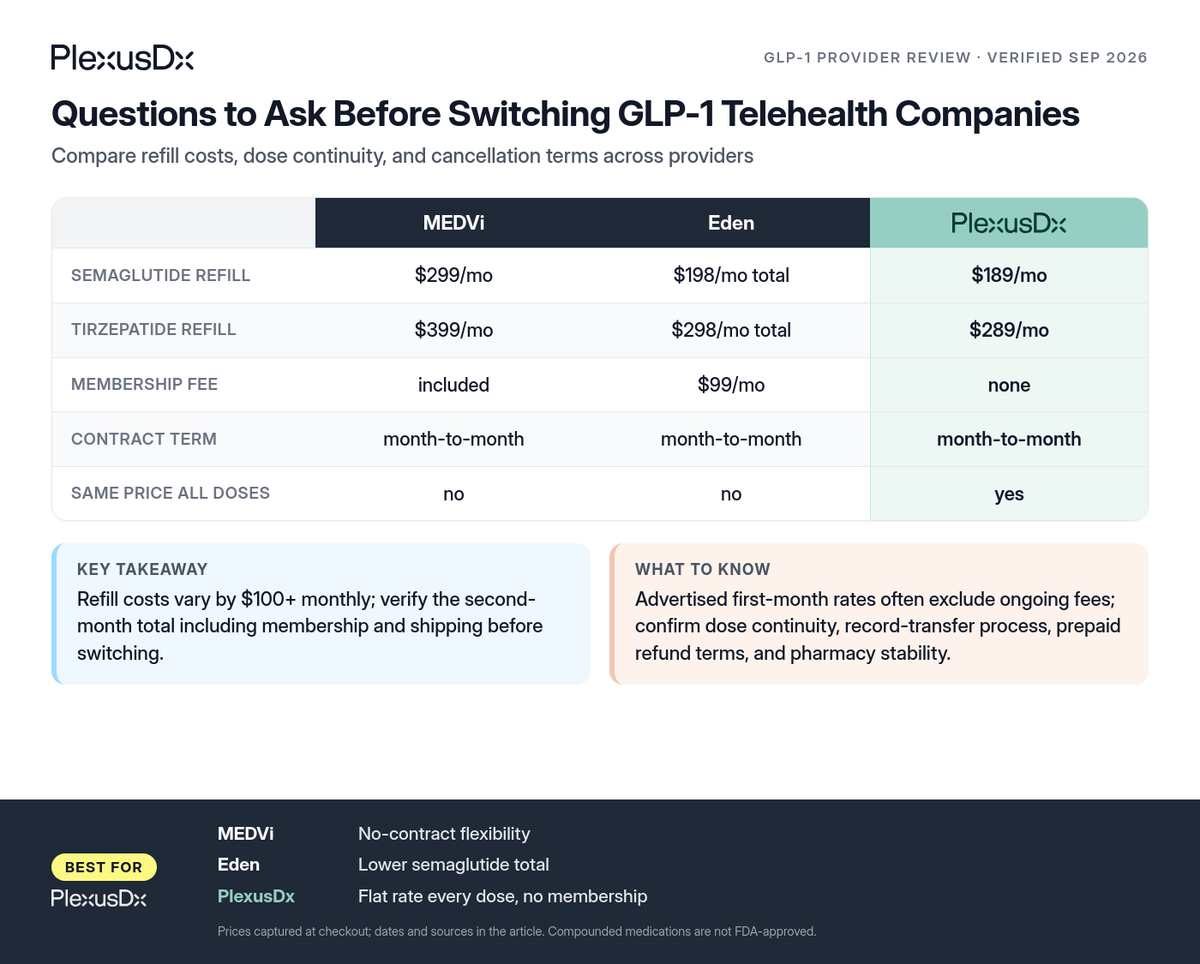
MEDVi advertises semaglutide injection at $179 for the first month; the refill rate is $299, and tirzepatide moves from a $279 introductory rate to a $399 refill (company website, captured September 4, 2026). Medication, clinician care, and shipping are included in those figures, and the service operates month-to-month with no contract.
Eden charges $99 per month for semaglutide medication plus a $99 monthly membership (total $198), and tirzepatide medication is $199 per month plus the same $99 membership (total $298). The membership carries a $39 introductory rate in the first month, then $99 ongoing (company website, captured September 4, 2026).
OrderlyMeds bundles the first two months of semaglutide at $149 total ($74.50 per month effective), then charges $149 per month ongoing; tirzepatide follows a $299 two-month starter ($149.50 per month effective) and $299 monthly thereafter (company website, captured September 4, 2026). No separate membership fee is advertised.
TrimRx advertises $199 semaglutide and $349 tirzepatide on its homepage, but checkout verification captured ongoing rates of $299 semaglutide and $399 tirzepatide; lower per-month rates appear on three-, six-, and twelve-month plans charged upfront (checkout verification, captured July 17–23, 2026).
PlexusDx publishes the same rate structure for every month: semaglutide injection is $189 month-to-month, $169 per month on a three-month plan, or $149 per month on a six-month plan; tirzepatide injection is $289 month-to-month, $269 per month on a three-month plan, or $249 per month on a six-month plan. No separate membership fee applies, and the price is identical at every dose (company website, captured July 17–23, 2026).
When comparing offers, write down the second-month total—medication, membership if any, and shipping if separate—and multiply by twelve. A $50 first-month discount becomes irrelevant when the refill cost is $100 higher than an alternative every month thereafter.
Question 2: Will you honor my current dose, or will I retitrate from the starting dose?
Dose continuity determines whether you maintain your current therapeutic benefit or lose weeks—sometimes months—retracing titration steps you have already completed. Some providers require every new patient to begin at the manufacturer's recommended starting dose regardless of prior treatment; others honor your established dose after clinical review.
If you are currently stable on semaglutide 1.0 mg weekly or tirzepatide 7.5 mg weekly, ask explicitly: "Will my first shipment contain my current dose, subject to provider approval, or will I start over at 0.25 mg semaglutide or 2.5 mg tirzepatide?" Request written confirmation. Verbal assurances during intake do not bind the prescribing clinician.
Forced retitration exposes you again to early-titration side effects—nausea, fatigue, gastrointestinal upset—that you may have already tolerated and moved past. It also delays your maintenance phase, which is the period in which most patients achieve stable weight loss and metabolic benefit. Retitration is clinically appropriate when your prior records are incomplete or when safety concerns exist, but it should never be a blanket administrative policy.
PlexusDx intake asks for your current medication and dose; the prescribing provider reviews that information and, when records support it and no contraindication appears, approves continuation at your current dose. The same clinical judgment applies at every provider—the question is whether the default assumption is continuation or restart.
Question 3: How do I transfer my medical records, and who initiates the request?
Medical record transfers follow one of three models: (1) you download records from your prior provider and upload them during intake, (2) the new provider contacts your prior provider directly after you sign a release, or (3) the new provider requests records and you supply them if the prior provider does not respond within a set window.
Each model assigns responsibility differently. In model one, delays are entirely within your control but require you to navigate your prior provider's patient portal, locate the correct documents, and ensure completeness. In model two, the new provider manages the request, but you lose visibility into timing and may not learn of a missing document until the request times out. Model three splits responsibility and creates the most potential for confusion.
Before you cancel your prior service, ask the new provider: "Will you request my records directly from [prior provider name], or do I need to supply them?" If you must supply them, download everything—visit notes, prescriptions, lab results if available—before you cancel, because some providers restrict portal access immediately upon cancellation.
One captured Trustpilot report describes a patient who experienced an eleven-day order delay and was repeatedly asked for records the prior provider (Eden, in this case) had already issued (Trustpilot, captured September 4, 2026). That report is a single anecdote, not evidence of a systemic problem, but it illustrates the consequence of unclear handoff responsibility: the patient expected the new provider to retrieve records automatically, and the new provider expected the patient to supply them proactively.
PlexusDx intake includes a consent form authorizing record requests and asks whether you can upload prior visit notes and prescriptions during the intake session. When you supply documents directly, approval typically occurs within one business day; when PlexusDx must request records from another telehealth company, the timeline extends to match that company's response speed, which varies.
Question 4: What are the cancellation terms, and will I receive a prorated refund if I prepay?
Month-to-month plans carry minimal cancellation risk: you stop paying when you stop using the service. Prepaid multi-month and annual plans lock in capital, and refund policies vary from full prorates to no refunds after a short trial window.
Found offers a cash-pay annual plan at $169 per month effective, which requires $2,028 upfront for twelve months; the monthly cash rate is $289 for semaglutide or $359 for tirzepatide. The $120-per-month difference ($1,440 over a year) is the economic incentive to prepay, but you must confirm in writing whether cancellation after month six would yield a prorated refund of the remaining six months or forfeit that capital (company website, captured September 4, 2026).
Hims & Hers advertises compounded semaglutide at $199 per month effective when you prepay six months ($1,194 upfront). The equivalent month-to-month rate is not prominently published, so the comparison requires you to ask for both the six-month-prepaid cost and the true monthly ongoing rate, then calculate the spread and weigh it against refund risk (company website, captured September 4, 2026).
Calibrate operates a twelve-month Metabolic Reset program at $199 per month ($2,388 total), with medication, labs, and copays billed separately and a limited refund policy. The program is structured as a fixed-duration commitment rather than an ongoing subscription (company website, captured September 4, 2026).
Before you prepay anything, ask: "If I cancel after [X] months, will I receive a prorated refund of the unused portion, and how many business days does the refund require?" Request the answer in writing—email is sufficient—and keep that email. If the provider will not commit to a written refund policy before purchase, that silence is decision-useful information.
PlexusDx pricing is structured month-to-month, three-month, and six-month; the six-month plan delivers the lowest per-month rate ($149 semaglutide injection, $249 tirzepatide injection) but does require payment in full at the start of the term. Cancellation and refund terms are governed by the prescribing provider's policies and are disclosed during intake.
Ready to compare your current plan against flat-rate, no-membership pricing?
A licensed provider will review your current dose and treatment history during a brief intake.
Start My 60-Second Intake →About 60 seconds · $0 charged until provider approval.
Question 5: Has your pharmacy network changed recently, and is another change planned?
Compounded GLP-1 medications are prepared by licensed 503A compounding pharmacies under state and federal oversight. Telehealth companies contract with one or more pharmacies in that network, and when a company changes pharmacy partners—whether for capacity, cost, or regulatory reasons—patients may experience fulfillment delays, formulation differences (for example, a switch from bacteriostatic water to sterile saline as the reconstitution vehicle), or a requirement for a new prescription if state pharmacy law treats the new pharmacy as a separate dispensing entity.
Pharmacy transitions are not inherently negative, but advance notice allows you to plan. If you are switching to a new provider in mid-December and that provider is scheduled to change pharmacies in early January, your first refill may be delayed while the new pharmacy integrates your prescription and shipping information.
Ask: "Which compounding pharmacy fulfills my prescription, and has that pharmacy changed in the past 90 days or is a change planned in the next 90 days?" A provider that has recently completed a pharmacy migration is less likely to initiate another one soon; a provider that deflects the question or cannot name its pharmacy may be in the middle of a transition it has not yet announced publicly.
PlexusDx works with licensed 503A compounding pharmacies and discloses the fulfilling pharmacy to patients during the prescription approval process. Pharmacy partnerships are reviewed periodically for quality, capacity, and regulatory compliance.
Supporting questions: insurance, branded options, and formulary differences
Does the new provider support insurance claims for branded GLP-1 medications?
Most telehealth providers in this comparison dispense compounded semaglutide and tirzepatide, which are not covered by insurance. A smaller subset—Ro, WeightWatchers Clinic, LifeMD, Form Health, and Found (insurance-support tier)—offer pathways to branded Wegovy, Ozempic, Zepbound, or Mounjaro and will submit prior-authorization requests on your behalf.
If your insurance plan covers branded GLP-1s for weight management and you meet the prior-authorization criteria, the branded path can reduce your out-of-pocket cost to the plan's specialty-tier copay—often $30 to $75 per month. The trade-off is prior-authorization friction: insurers frequently require documentation of BMI ≥30 (or ≥27 with comorbidity), prior weight-loss attempts, and sometimes a psychiatric clearance or nutrition counseling attestation. Approvals can take two to six weeks, and denials are common.
Ro's Body Program charges a membership fee ($149 per month, or lower on prepaid six-month and annual terms) and bills branded medication separately at $149–$299 per month for Wegovy (dose-dependent) or $299–$449 per month for Zepbound (company website, captured September 4, 2026). Found's insurance-support monthly plan is $199 per month plus the typical copay, and the annual prepaid version is $99 per month effective ($1,188 upfront) plus copay (company website, captured September 4, 2026). Those membership or program fees persist even if your insurance claim is denied and you revert to self-pay compounded medication.
If you are switching specifically to pursue insurance coverage, ask the new provider: "What is the prior-authorization approval rate for my insurance plan, and what is my total monthly cost if the claim is denied?" The second question reveals whether you are committing to a high membership fee on the chance of approval or whether the fallback self-pay rate remains competitive.
Does the provider offer oral GLP-1 formulations, and how does pricing compare?
Oral semaglutide and oral tirzepatide (dissolving tablets or capsules) eliminate the need for subcutaneous injection and appeal to patients who prefer not to self-inject or who travel frequently and want to avoid carrying syringes and refrigeration.
PlexusDx offers oral semaglutide capsules at $289 month-to-month, $269 per month on a three-month plan, or $249 per month on a six-month plan, and oral tirzepatide capsules at $349 month-to-month, $299 per month on a three-month plan, or $279 per month on a six-month plan (company website, captured July 17–23, 2026).
Henry Meds offers tirzepatide only as an oral dissolving tablet; three-month supply is $891 ($297 per month effective). Henry Meds does not currently dispense injectable tirzepatide (company website, captured September 4, 2026).
Oral formulations typically cost more per month than injections of the same compound due to differences in bioavailability and compounding complexity. If you are switching primarily to access an oral option, confirm that the provider's formulary includes it and compare the oral price to your current injectable cost—the convenience premium may be $50 to $100 per month.
What is the provider's Trustpilot rating, and what do recent reviews report?
Service-quality signals—Trustpilot ratings, review volume, and thematic complaints—help you forecast the likelihood of responsive customer support, on-time fulfillment, and effective clinical communication after you switch.
PlexusDx holds a 4.3-star rating on Trustpilot, with 79% of reviews at five stars and 83% at four stars or higher (captured September 9, 2026; trustpilot.com/review/plexusdx.com).
Henry Meds holds 4.4 stars across approximately 13,000 reviews; Mochi Health 4.5 stars across approximately 18,000 reviews; Eden 4.5 stars across approximately 5,000 reviews; MEDVi 4.3 stars across approximately 15,000 reviews; OrderlyMeds 3.6 stars across approximately 634 reviews; Fridays Health 4.2 stars across approximately 4,700 reviews; Found 4.1 stars across approximately 732 reviews; and Noom Med 4.5 stars across approximately 67,000 reviews (profile-wide) (all captured September 4, 2026 from Trustpilot).
Review volume matters as much as average rating: a 4.5-star rating from 50 reviews is less reliable than a 4.2-star rating from 5,000 reviews. High-volume profiles reveal patterns. Captured negative reports for OrderlyMeds mention fast charging but slow refunds, non-response to support inquiries, delayed shipping, pharmacy changes without notice, and unwanted calls or texts after opt-out requests. One Eden report cites an eleven-day order delay and repeated requests for records Eden had previously issued. A Mochi Health example describes a provider appearing late to a video visit and not engaging meaningfully. These are individual reports, not systemic findings, but recurring themes across dozens of reviews carry more weight than isolated complaints (all Trustpilot, captured September 4, 2026).
Before you switch, search "[provider name] Trustpilot" and read the ten most recent one-star and two-star reviews. If the same operational failure—delayed refunds, unresponsive support, surprise charges—appears repeatedly in recent reports, treat that pattern as a forecast of your own experience under load.
Normalized 12-month cost comparison: switching scenarios
The table below models the total 12-month cost for semaglutide injection under each provider's ongoing refill structure, assuming no dose changes and no promotional first-month rates (we isolate the sustainable recurring cost). Where a provider offers multiple term lengths, we show the month-to-month rate and the lowest prepaid effective rate. All dollar figures are captured from company websites or checkout verification between July 17 and September 4, 2026; calculations of 12-month totals are ours.
| Provider |
Semaglutide Monthly (MTM or Standard) |
12-Month Total (MTM) |
Lowest Prepaid Rate |
12-Month Total (Prepaid) |
| PlexusDx |
$189 MTM |
$2,268 |
$149/mo (6-month plan) |
$1,788 (our calculation) |
| MEDVi |
$299 refill |
$3,588 |
— |
— |
| Eden |
$198 ($99 med + $99 membership) |
$2,376 |
— |
— |
| OrderlyMeds |
$149 ongoing (after 2-month starter) |
$1,788 |
— |
— |
| TrimRx |
$299 ongoing (checkout-verified) |
$3,588 |
Lower on 3-, 6-, 12-mo prepaid |
Not disclosed |
| Henry Meds |
$297 MTM |
$3,564 |
$197/mo (12-month paid-in-full) |
$2,364 |
| Embody |
$299 |
$3,588 |
— |
— |
| Peak Wellness |
$249 |
$2,988 |
Lower on 6-month prepaid |
Not disclosed |
| Fridays Health |
$249 advertised |
$2,988 |
Lower on multi-month prepay |
Not disclosed |
| ShedRx |
$149 advertised |
$1,788 |
— |
— |
| Amble |
$179 |
$2,148 |
— |
— |
| Hims & Hers |
Not published MTM |
— |
$199/mo (6-month prepaid, $1,194 upfront) |
$2,388 (our calculation) |
| Found (cash-pay) |
$289 MTM |
$3,468 |
$169/mo (annual, $2,028 upfront) |
$2,028 |
The lowest month-to-month recurring cost in this sample is OrderlyMeds at $149 per month ongoing ($1,788 over twelve months) and ShedRx at $149 advertised, both matching PlexusDx six-month effective rate of $149 per month. The highest month-to-month rate is MEDVi refill at $299 ($3,588 annually), TrimRx checkout-verified $299, Embody $299, and Henry Meds month-to-month $297. When prepayment is available, PlexusDx six-month ($1,788 total), Found annual cash-pay ($2,028), and Henry Meds twelve-month paid-in-full ($2,364) deliver the steepest per-month discounts.
OrderlyMeds' ongoing $149 rate and 3.6-star Trustpilot profile (with recurring complaints about slow refunds and support non-response) illustrate the trade-off: low price may correlate with constrained operational capacity. PlexusDx $149 six-month rate is identical in cost but pairs with a 4.3-star Trustpilot rating, 83% four-star-or-higher reviews, and no separate membership fee.
Choose PlexusDx if…
- You want month-to-month flexibility with the option to lock in a lower rate by prepaying three or six months, with no recurring membership fee at any term length.
- You value same-price-every-dose transparency—PlexusDx charges $189, $169, or $149 per month for semaglutide injection (depending on term) whether you are on 0.25 mg or 2.4 mg.
- You prefer to avoid the administrative step of separating medication cost from membership cost; PlexusDx publishes one all-in figure.
- You are switching from a provider that forced retitration and want explicit intake questions about your current dose and treatment history so the new prescriber can honor continuity where clinically appropriate.
- You want access to both injectable and oral formulations of semaglutide and tirzepatide under a single pricing structure.
Choose another provider if…
- Your insurance covers branded Wegovy, Ozempic, Zepbound, or Mounjaro and you meet prior-authorization criteria—Ro, Found (insurance-support tier), WeightWatchers Clinic, LifeMD, and Form Health support those claims and your effective cost may drop to your plan's specialty copay.
- You want a coaching-intensive program with registered dietitians, behavioral support, and structured curriculum—Found, Calibrate, Noom Med, and WeightWatchers Clinic build comprehensive lifestyle programs around the medication, which PlexusDx does not.
- You prefer per-dose pricing that starts very low and scales only as you titrate—Mochi Health charges $60 per month for semaglutide starting dose and $90 per month for tirzepatide starting dose, plus a separate membership (company website, captured September 4, 2026).
- You need both GLP-1 medication and primary-care or multi-condition management under one platform—PlushCare offers general telemedicine visits at $129 self-pay (or $19.99 monthly membership with first 30 days free) and can prescribe GLP-1s within that broader scope (company website, captured September 4, 2026).
- You have had a positive established relationship with a specific provider and the cost difference is immaterial to your budget—continuity of care and trusted clinical rapport often outweigh a $50 per month price spread.
Methodology and freshness
All pricing, membership, cancellation, and Trustpilot figures were captured from company websites, checkout verification sessions, or Trustpilot profiles between July 17, 2026 and September 9, 2026. Where evidence conflicts—for example, a homepage teaser rate versus a checkout-verified rate—we note the conflict and cite the checkout figure as the operative price. Twelve-month cost totals and effective monthly rates derived from prepaid plans are our calculations and are labeled as such. We do not contact providers to request undisclosed information; this analysis reflects only what a prospective patient can verify independently before purchase. No provider paid for inclusion or exclusion. PlexusDx publishes this guide and is one of the providers discussed; we apply the same evidence rules to our own program and to competing programs.
Frequently Asked Questions
Can I switch GLP-1 providers mid-titration without restarting from the lowest dose?
Most providers will honor your current dose if you supply documentation—prior visit notes, prescription records, or a letter from your previous prescriber. Switching mid-titration is clinically appropriate as long as the new provider's clinician reviews your history and confirms you tolerated the current dose without adverse events. Forced retitration is a policy choice, not a medical requirement, so ask explicitly during intake whether continuation at your current dose is the default or the exception.
What happens to my unused medication if I switch providers before my current supply runs out?
Compounded GLP-1 medications are patient-specific prescriptions and cannot be transferred, returned for credit, or used under a different provider's prescription. If you have two weeks of semaglutide remaining and you start with a new provider immediately, you will receive a new shipment and effectively pay for overlapping supply. The economically efficient approach is to time your switch so your current supply depletes within a few days of your new shipment's expected arrival, but that requires confidence in the new provider's fulfillment speed—confirm typical time-from-approval-to-delivery before you cancel your current subscription.
Do I need a new baseline lab panel when I switch providers, or can I transfer recent results?
Clinical best practices recommend baseline labs—comprehensive metabolic panel, lipid panel, hemoglobin A1C, and thyroid function at minimum—before initiating GLP-1 therapy. If you completed labs within the past six months under your prior provider and you can download and upload those results during intake, most new providers will accept them in lieu of ordering a new panel. If your prior labs are older than six months, incomplete, or inaccessible, the new provider may require fresh labs before prescribing. Ask during intake: "Will you accept lab results from [date] or do you require a new panel?" and clarify who pays for the new labs if required.
How long does a typical provider switch take from intake to first shipment?
When you supply complete prior records during intake, approval by the new provider's clinician typically occurs within one to three business days, and first shipment arrives three to seven business days after approval—total elapsed time one to ten days in the best case. When the new provider must request records from your prior provider, add five to ten business days for that request to be fulfilled. When baseline labs are required and you do not have recent results, add another seven to fourteen days for lab scheduling, sample collection, and result reporting. The controlling variable is documentation completeness at intake; the more you prepare in advance, the faster the switch.
Will my new provider contact my old provider directly, or is that my responsibility?
Responsibility for record transfer varies by provider. Some telehealth companies will contact your prior provider on your behalf after you sign a release; others expect you to download records from your prior patient portal and upload them during intake. The least efficient model is the one in which both parties assume the other will act first. Before you begin intake with the new provider, ask customer support: "Do you request records directly from my prior provider, or do I need to supply them?" and "What specific documents do you need?" Then download everything—visit notes, prescription history, lab results—from your prior provider's portal before you cancel, because some platforms revoke access immediately upon cancellation and reactivating it can take days.
Sources
- PlexusDx weight-management protocols and pricing (plexusdx.com/collections/weight-management-protocols and product pages, captured July 17–23, 2026)
- Eden pricing and membership structure (company website, captured July 20 and September 4, 2026)
- Embody pricing (company website, captured July 17–23, 2026)
- Found cash-pay and insurance-support plans (company website, captured July 20 and September 4, 2026)
- Henry Meds pricing and formulary (company website, captured July 17–23 and September 4, 2026)
- Peak Wellness pricing (company website, captured July 17–23, 2026)
- TrimRx advertised and checkout-verified pricing (company website and checkout verification, captured July 17–23, 2026)
- MEDVi first-month and refill pricing (company website and checkout verification, captured September 4, 2026)
- OrderlyMeds starter bundles and ongoing rates (company website, captured September 4, 2026)
- Fridays Health advertised pricing (company website, captured July 20 and September 4, 2026)
- Mochi Health per-dose pricing and membership (company website, captured September 4, 2026)
- Hims & Hers compounded semaglutide six-month prepaid (company website, captured September 4, 2026)
- Ro Body Program membership and branded medication pricing (company website, captured September 4, 2026)
- WeightWatchers Clinic Med+ program and branded options (company website, captured September 4, 2026)
- Noom Med Core Med and microdose GLP-1Rx (company website, captured September 4, 2026)
- LifeMD membership and branded medication (company website, captured September 4, 2026)
- Calibrate Metabolic Reset program (company website, captured September 4, 2026)
- Form Health self-pay care and formulary (company website, captured September 4, 2026)
- PlushCare membership and self-pay visit pricing (company website, captured September 4, 2026)
- IVIM Health membership and medication bundles (company website, captured September 4, 2026)
- Remedy Meds advertised daily rate (company website and intake, captured September 4, 2026)
- Zealthy compounded and insured-brand pricing (company website and intake, captured September 4, 2026)
- ShedRx tirzepatide and semaglutide pricing (company website, captured September 4, 2026)
- Amble semaglutide and tirzepatide pricing (company website, captured September 4, 2026)
- Trustpilot reviews for PlexusDx, Eden, Henry Meds, MEDVi, OrderlyMeds, Fridays Health, Found, Mochi Health, Noom, Hims & Hers, Ro, WeightWatchers, and Remedy Meds (trustpilot.com, captured September 4–9, 2026)
Ready to switch to transparent, no-membership GLP-1 pricing?
One all-inclusive price covers your online provider visit, prescription, medication, and shipping—no membership, no hidden fees. Complete a short intake and a licensed provider reviews your fit.
Start My Intake →
Compounded medication disclosure: Compounded medications are not FDA-approved. FDA does not review compounded drugs before marketing for safety, effectiveness, or quality. A licensed clinician determines whether a prescription is appropriate for an individual patient. PlexusDx works with licensed 503A compounding pharmacies.
Medical and Editorial Standards
Medical review process: This article was reviewed for medical accuracy, scientific clarity, evidence alignment, and appropriate discussion of genetics, medications, supplements, biomarkers, and health-related claims.
Sources and evidence: PlexusDx educational content is developed using peer-reviewed research, clinical literature, reputable medical references, and, where applicable, public health or regulatory guidance. References are included at the end of the article when scientific, medical, or health-related claims are discussed.
Commercial transparency: PlexusDx offers genetic testing, blood biomarker testing, personalized supplement recommendations, and related precision wellness services. Product mentions are intended to help readers understand available options and should not be interpreted as medical advice.
Important disclaimer: PlexusDx educational content is for informational purposes only and should not be used as a substitute for professional medical advice, diagnosis, or treatment. Always consult a qualified healthcare provider before making decisions about medications, supplements, genetic testing, lab testing, or health-related care.


Share:
Can You Transfer a High-Dose Tirzepatide Prescription to Another
Changing Telehealth Weight-Loss Clinics: Cost and Process in 2026