Last reviewed: September 13, 2026
Last updated: September 13, 2026
Written by: Jay Hastings, CEO of PlexusDx
Jay Hastings is the CEO of PlexusDx, a precision health company focused on genetic testing, blood biomarker insights, and personalized wellness recommendations. He has more than 20 years of experience across healthcare innovation, genomics, laboratory operations, healthcare investing, and strategic finance. His work has included scaling healthcare startups, leading CLIA lab integrations, and helping expand consumer access to precision health tools.
Medically reviewed by: Jayden Lee, PharmD, EMBA
Jayden Lee, PharmD, EMBA, is the PlexusDx Medical Science Liaison with a PharmD and MBA specializing in pharmacogenomics and clinical product development, with a proven ability to bridge the gap between genomic research and practical patient outcomes. Dr. Lee has more than 10 years of professional experience in clinical pharmacy, academia, and research.
PlexusDx publishes this comparison and is one of the providers discussed. We use the same evidence rules for our own program and competing programs.
The short answer
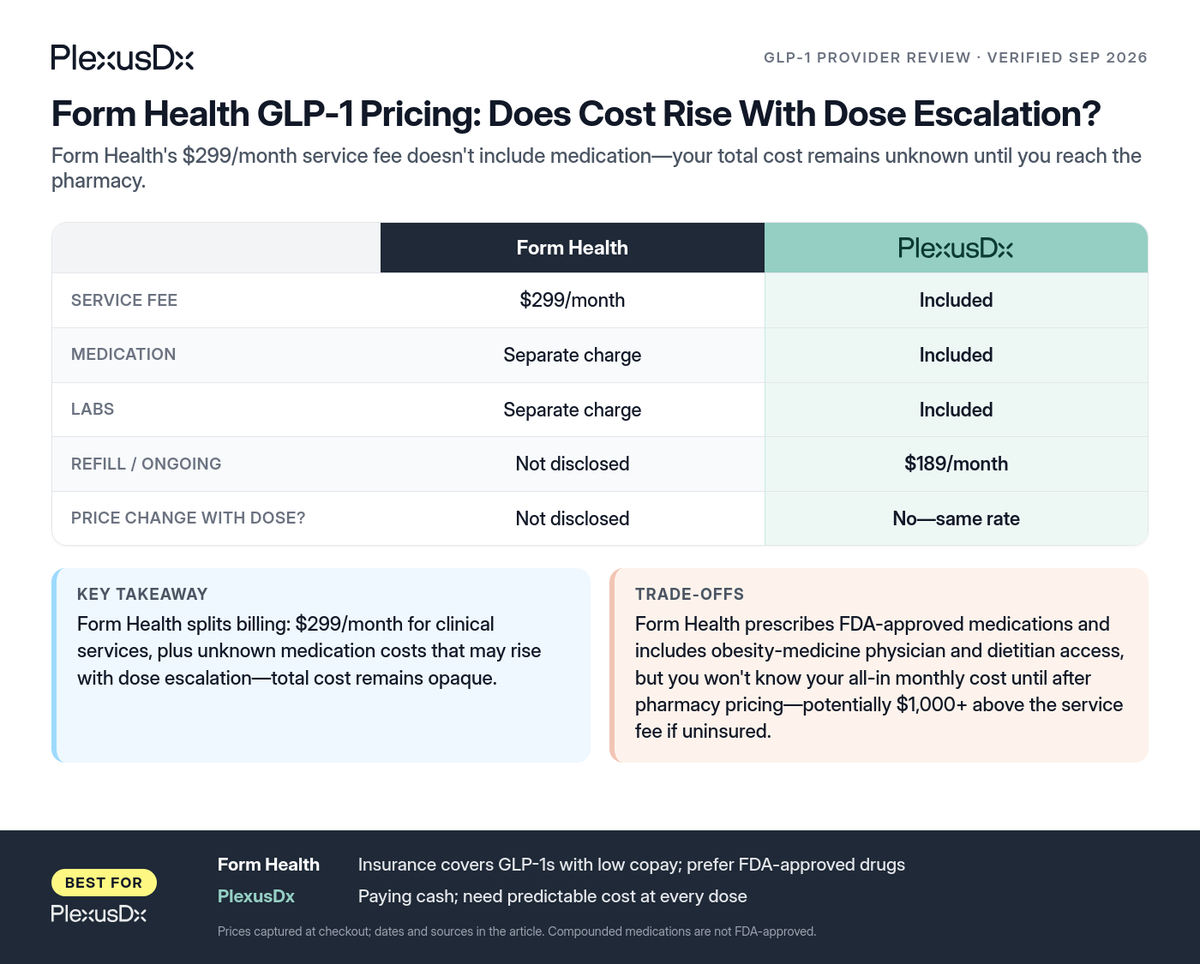
Form Health's published pricing splits clinical services from medication costs. The service component—obesity-medicine physician care, dietitian access, and messaging support—runs $299 per month on a standard monthly billing cycle. Medications, however, are purchased separately, and Form Health does not publish dose-specific pricing for Wegovy, Zepbound, Saxenda, or other FDA-approved GLP-1 medications it prescribes. Whether your medication cost increases as your provider raises your dose from starter (0.25 mg semaglutide weekly, for example) to maintenance (2.4 mg weekly) depends on pharmacy pricing and your insurance coverage, neither of which Form Health controls or discloses in advance. The result: your total monthly cost—service fee plus medication—likely changes during treatment, but by how much remains opaque until you reach the pharmacy counter or submit an insurance claim.
Want predictable monthly costs across every dose level?
PlexusDx charges the same all-in rate whether you're on a starter dose or maintenance—no surprises as treatment progresses.
See weight-management protocols →
At a glance: Form Health service fee vs all-in alternatives
| Component |
Form Health |
PlexusDx (compounded semaglutide injection) |
| Service fee |
$299/month (physician + dietitian + messaging) |
Included |
| Medication |
Separate charge; pricing not published |
Included |
| Labs |
Separate charge |
Included |
| All-in month-to-month rate |
Not disclosed (service + medication + labs) |
$189/month |
| Medication type |
FDA-approved (Wegovy, Zepbound, Saxenda, others) |
Compounded semaglutide |
| Price changes with dose? |
Not disclosed (depends on pharmacy/insurance) |
No—same rate at every dose |
Form Health figures captured September 4, 2026 from formhealth.co/faqs; PlexusDx prices current as of September 13, 2026.
Why Form Health's dose-cost question has no public answer
Most telehealth GLP-1 programs bundle medication, provider visits, and support into a single monthly price. Form Health takes a different approach: you pay $299 per month for access to an obesity-medicine physician and a registered dietitian, plus asynchronous messaging between appointments. The medication itself—whether Wegovy (semaglutide), Zepbound (tirzepatide), or Saxenda (liraglutide)—is prescribed by your Form Health physician but filled and billed separately, typically through a specialty pharmacy or your insurance's preferred network.
This split-billing structure means your total monthly outlay has two moving parts. The service fee is fixed and predictable: $299 every month you remain enrolled. The medication cost, however, depends on variables Form Health does not publish:
-
Pharmacy cash price for the specific dose your provider prescribes (starter doses of FDA-approved GLP-1s often cost less than maintenance doses at retail).
-
Insurance formulary tier and whether your plan covers obesity medications (many exclude them, forcing full cash pay).
-
Copay or coinsurance if your plan does cover the drug—figures that vary widely by plan design.
-
Manufacturer coupon eligibility (Novo Nordisk and Eli Lilly offer savings programs for commercially insured patients, but rules change frequently).
Because Form Health uses FDA-approved medications filled through traditional pharmacies rather than compounded drugs shipped from a central facility, the company has limited control over—and apparently chooses not to publish—medication pricing. The FAQ page states that "insurance cost depends on your plan" and confirms that "labs and medications are separate" from the $299 monthly service fee, but it offers no dose-specific cost examples.
In practical terms, this means you will not know your all-in monthly cost until after your initial physician visit, prescription submission, and pharmacy pricing inquiry. If your insurance does not cover Wegovy or Zepbound, and you cannot access a manufacturer savings card, retail cash prices for maintenance doses can exceed $1,000 per month—far above the $299 service fee.
The economic structure: service fee vs total cost
Form Health's model separates clinical overhead from pharmaceutical expense. Over twelve months, the service component alone totals $3,588 ($299 × 12). Medication and lab costs add an unknown amount on top of that baseline.
For comparison, PlexusDx charges $189 per month month-to-month for compounded semaglutide injection, with medication, provider access, and labs included. That rate remains the same whether you are on 0.25 mg weekly (typical starting dose) or 2.4 mg weekly (typical maintenance dose). Twelve months at $189 totals $2,268—$1,320 below Form Health's service fee alone, and thousands below a realistic all-in cost once you add Form Health's separate medication charges.
If you commit to a six-month supply with PlexusDx, the per-month rate drops to $149—$894 over six months versus $1,794 for Form Health's service fee alone during the same period (our calculation, based on prepaid six-month pricing).
One flat rate covers your medication, provider visit, and every dose increase
A licensed clinician reviews your intake to confirm fit—no charge until approved.
Start My 60-Second Intake →About 60 seconds · $0 charged until provider approval.
Where insurance changes the picture (and where it doesn't)
If you carry commercial insurance that covers Wegovy or Zepbound with a reasonable copay—say, a $25 or $50 monthly specialty-tier copay—Form Health's split-billing model can work in your favor. You would pay the $299 service fee plus your copay, potentially bringing your all-in cost to $324–$349 per month. In that scenario, the FDA-approved medication (which some patients and clinicians prefer over compounded alternatives) comes at a modest premium over compounded telehealth options.
Three limiting factors, however, narrow that favorable window:
-
Obesity-medication exclusions remain common. Many employer-sponsored and marketplace plans explicitly exclude GLP-1 receptor agonists when prescribed for weight management, even if they cover the same drugs for type 2 diabetes. If your plan excludes obesity indications, you pay the full retail or cash price—often $900–$1,300 per month for brand-name products—on top of the $299 service fee.
-
High-deductible plans shift cost to you. If you have not yet met your annual deductible, you pay the negotiated rate (typically lower than retail but still several hundred dollars per month) until the deductible is satisfied, then the copay or coinsurance kicks in. During the deductible phase, your total monthly cost can rival or exceed cash-pay compounded options.
-
Prior authorization delays and denials. Insurers that do cover GLP-1s for obesity often require step therapy (failed attempts at diet, exercise, or other medications) and prior authorization, which can delay treatment start by weeks and sometimes results in denial.
PlexusDx programs do not bill insurance and cannot accept insurance payment, so every patient pays the posted cash rate. That approach eliminates prior-authorization uncertainty and formulary disputes, but it also means you cannot apply the cost toward your deductible or out-of-pocket maximum, and you receive no insurer subsidy.
Dose escalation and cost trajectory
GLP-1 treatment protocols typically begin at a low dose to minimize gastrointestinal side effects, then increase every four weeks until reaching a maintenance dose that produces meaningful weight loss with acceptable tolerability. For semaglutide (Wegovy), the standard escalation runs from 0.25 mg weekly to 0.5 mg, 1 mg, 1.7 mg, and finally 2.4 mg over five months. Tirzepatide (Zepbound) follows a similar staircase from 2.5 mg weekly to 5 mg, 7.5 mg, 10 mg, 12.5 mg, and 15 mg.
With FDA-approved medications purchased through traditional pharmacies, the cost per pen or vial often rises with dose strength, particularly if you are paying cash or have not met your deductible. A one-month supply of Wegovy 0.25 mg starter pens typically costs less at retail than a one-month supply of Wegovy 2.4 mg pens, reflecting the higher milligram quantity of active ingredient. If Form Health patients pay cash or a percentage coinsurance (common in high-deductible plans), their medication expense would increase each time their provider raises the dose—though by precisely how much remains undisclosed in Form Health's public materials.
Compounded GLP-1 programs, by contrast, generally charge the same rate across all doses because the compounding pharmacy draws each dose from bulk semaglutide or tirzepatide powder and reconstitutes it to the prescribed strength. The incremental cost of dispensing 1 mg versus 0.25 mg is negligible, so providers can offer flat-rate pricing without risking a loss at higher doses. PlexusDx follows this model: $189 per month for compounded semaglutide injection whether you are on week one at 0.25 mg or month six at 2.4 mg.
Strengths of the Form Health model
Despite the pricing opacity, Form Health offers structural advantages that matter to certain patients:
-
FDA-approved medications exclusively. Every prescription written through Form Health is for a drug that has completed the FDA's full New Drug Application review—Wegovy, Zepbound, Saxenda, or similar products. Patients and clinicians who prefer the regulatory assurance, manufacturing oversight, and established safety data of FDA-approved drugs will find no compounded alternatives in Form Health's formulary.
-
Obesity-medicine physician oversight. Form Health's clinical team includes board-certified obesity-medicine specialists, a credential that requires additional training beyond general internal or family medicine. For patients with complex metabolic conditions or prior bariatric surgery, this depth of expertise can be material.
-
Integrated dietitian support. The $299 monthly fee includes access to a registered dietitian, not as an optional add-on but as a core component of the care model. If you value or need ongoing nutritional counseling—common among patients managing binge-eating disorder, food insecurity, or medical diets—that integration represents real value.
-
Insurance optionality. Because Form Health prescribes FDA-approved medications filled through traditional pharmacies, you can submit claims to your insurer if your plan covers obesity drugs. Patients with generous pharmacy benefits may end up with lower out-of-pocket costs than any cash-pay telehealth alternative.
Where the model shows gaps
The same structural features that create Form Health's strengths also introduce friction and cost uncertainty:
-
No advance clarity on total cost. You commit to the $299 monthly service fee before knowing what your medication will cost each month. If your insurance denies coverage or you face a high coinsurance rate, you discover the true expense only after your first fill—potentially weeks into treatment.
-
Medication and service billed separately. Two charges hit your accounts each month (or more, if labs are ordered), complicating budgeting and increasing the administrative surface area for billing questions or disputes.
-
No dose-cost transparency. Even cash-pay patients receive no published schedule showing what a 0.5 mg Wegovy pen costs versus a 1.7 mg pen. You must call the pharmacy or submit the prescription to learn the figure.
-
Higher floor than compounded alternatives. The $299 service fee alone exceeds the all-in month-to-month price of many compounded GLP-1 programs before you add medication costs. For uninsured or high-deductible patients paying cash for brand-name drugs, the delta can reach $1,000 or more per month.
Choose Form Health if…
Form Health makes the most sense when you prioritize FDA-approved medications and carry insurance likely to cover them with a manageable copay. Specifically, consider Form Health if:
- Your commercial insurance plan includes GLP-1 receptor agonists on its formulary for obesity or weight management, with a copay (not coinsurance) below $100.
- You have already confirmed coverage and prior-authorization requirements with your insurer, and you know the monthly medication cost in advance.
- You prefer or require care from a board-certified obesity-medicine physician, and you value integrated dietitian access as part of the base service rather than an add-on.
- You are willing to manage split billing—service fee to Form Health, medication cost to the pharmacy—across multiple payment streams each month.
- You have a strong preference for FDA-approved drugs and are unwilling to use compounded semaglutide or tirzepatide under any circumstance.
Where PlexusDx fits
PlexusDx serves patients who want cost certainty, all-in pricing, and no insurance complexity. The model works best when:
- You are paying cash (uninsured, high-deductible plan not yet met, or insurance excludes obesity medications) and need the lowest predictable monthly rate.
- You want the same price at every dose level, eliminating cost increases as your provider escalates your prescription during the first months of treatment.
- You prefer a single monthly charge that includes medication, provider access, and labs—no separate pharmacy bills, no prior authorization, no formulary appeals.
- You are comfortable with compounded semaglutide or tirzepatide prepared by a licensed 503A compounding pharmacy under the oversight of a prescribing clinician.
- You value the option to lock in a lower per-month rate through three-month ($169/month for semaglutide injection) or six-month ($149/month) commitments.
PlexusDx holds a 4.3-star rating on Trustpilot, with 79% of reviews at five stars and 83% at four stars or higher (captured September 9, 2026; trustpilot.com/review/plexusdx.com).
Methodology and freshness
Form Health pricing and service-model details were captured September 4, 2026 from the company's FAQ page at formhealth.co/faqs. The evidence documents the $299 monthly service fee and confirms that medications and labs are billed separately, but it includes no dose-specific medication pricing, no insurance reimbursement examples, and no total-cost illustrations. We contacted no pharmacy partners and received no proprietary pricing data; all conclusions about dose-cost variability rest on the general structure of FDA-approved GLP-1 retail pricing, which typically increases with dose strength.
PlexusDx pricing reflects month-to-month rates current as of September 13, 2026. The 12-month cost comparison for Form Health's service component ($3,588) and PlexusDx compounded semaglutide injection ($2,268) are our calculations, multiplying published monthly rates by twelve. The six-month prepaid comparison ($1,794 vs $894) is also our calculation, based on Form Health's standard $299 monthly rate and PlexusDx's six-month rate of $149 per month for semaglutide injection. These calculations exclude Form Health's separate medication and lab costs, which remain undisclosed.
No promotional or introductory rates were identified for either program. All figures represent standard ongoing pricing as published on the respective company websites.
Frequently Asked Questions
Does Form Health charge more when my semaglutide dose increases from 0.5 mg to 1 mg?
Form Health's $299 monthly service fee remains constant across all doses. However, your medication is billed separately through a pharmacy, and retail pricing for FDA-approved drugs like Wegovy often increases with dose strength. The exact cost difference depends on whether you pay cash, use insurance, or qualify for a manufacturer savings program.
Can I use my insurance to cover the medication Form Health prescribes?
Yes. Form Health prescribes FDA-approved medications filled through traditional pharmacies, so you can submit claims to your insurer if your plan covers GLP-1 receptor agonists for obesity. Many plans exclude obesity indications or require prior authorization, so confirm coverage and copay details with your insurer before starting treatment.
What is included in the $299 monthly Form Health fee?
The $299 covers access to an obesity-medicine physician, a registered dietitian, and asynchronous messaging between scheduled visits. It does not include the cost of medications, which are prescribed by your Form Health provider but purchased separately from a pharmacy, or lab tests, which are also billed separately.
How does PlexusDx keep the same price at higher GLP-1 doses?
PlexusDx uses compounded semaglutide and tirzepatide, where each dose is prepared from bulk powder by a licensed 503A compounding pharmacy. The incremental cost of compounding a higher-strength dose is minimal, allowing the program to charge a flat rate—$189 per month for compounded semaglutide injection—regardless of whether you receive 0.25 mg or 2.4 mg weekly.
Which program costs less over a full year of treatment?
PlexusDx compounded semaglutide injection totals $2,268 over twelve months at the month-to-month rate, or $1,788 on a six-month commitment. Form Health's service fee alone totals $3,588 annually, and you must add separate medication costs (often hundreds of dollars per month for cash-pay patients on FDA-approved drugs) to reach your true annual outlay. If your insurance covers Wegovy with a low copay, Form Health may close that gap.
Sources
- Form Health FAQ page, formhealth.co/faqs, accessed September 4, 2026
- Form Health Trustpilot profile, trustpilot.com/review/formhealth.co, accessed September 4, 2026
- PlexusDx Trustpilot profile, trustpilot.com/review/plexusdx.com, accessed September 9, 2026
- PlexusDx product pages and pricing data, plexusdx.com, accessed September 13, 2026
Ready to lock in one predictable rate across every dose?
One all-inclusive price covers your online provider visit, prescription, medication, and shipping—no membership, no hidden fees. Complete a short intake and a licensed provider reviews your fit.
Start My Intake →
Compounded medication disclosure: Compounded medications are not FDA-approved. FDA does not review compounded drugs before marketing for safety, effectiveness, or quality. PlexusDx works with licensed 503A compounding pharmacies. A licensed clinician determines whether a prescription is appropriate for an individual patient.
Medical and Editorial Standards
Medical review process: This article was reviewed for medical accuracy, scientific clarity, evidence alignment, and appropriate discussion of genetics, medications, supplements, biomarkers, and health-related claims.
Sources and evidence: PlexusDx educational content is developed using peer-reviewed research, clinical literature, reputable medical references, and, where applicable, public health or regulatory guidance. References are included at the end of the article when scientific, medical, or health-related claims are discussed.
Commercial transparency: PlexusDx offers genetic testing, blood biomarker testing, personalized supplement recommendations, and related precision wellness services. Product mentions are intended to help readers understand available options and should not be interpreted as medical advice.
Important disclaimer: PlexusDx educational content is for informational purposes only and should not be used as a substitute for professional medical advice, diagnosis, or treatment. Always consult a qualified healthcare provider before making decisions about medications, supplements, genetic testing, lab testing, or health-related care.

Share:
Cheaper Alternatives to ReflexMD: 2026 GLP-1 Providers Compared
Does Found Raise GLP-1 Prices When Your Dose Increases? — 2026