Last reviewed: September 20, 2026
Last updated: September 20, 2026
Written by: Jay Hastings, CEO of PlexusDx
Jay Hastings is the CEO of PlexusDx, a precision health company focused on genetic testing, blood biomarker insights, and personalized wellness recommendations. He has more than 20 years of experience across healthcare innovation, genomics, laboratory operations, healthcare investing, and strategic finance. His work has included scaling healthcare startups, leading CLIA lab integrations, and helping expand consumer access to precision health tools.
Medically reviewed by: Jayden Lee, PharmD, EMBA
Jayden Lee, PharmD, EMBA, is the PlexusDx Medical Science Liaison with a PharmD and MBA specializing in pharmacogenomics and clinical product development, with a proven ability to bridge the gap between genomic research and practical patient outcomes. Dr. Lee has more than 10 years of professional experience in clinical pharmacy, academia, and research.
PlexusDx publishes this comparison and is one of the providers discussed. We use the same evidence rules for our own program and competing programs.
The short answer
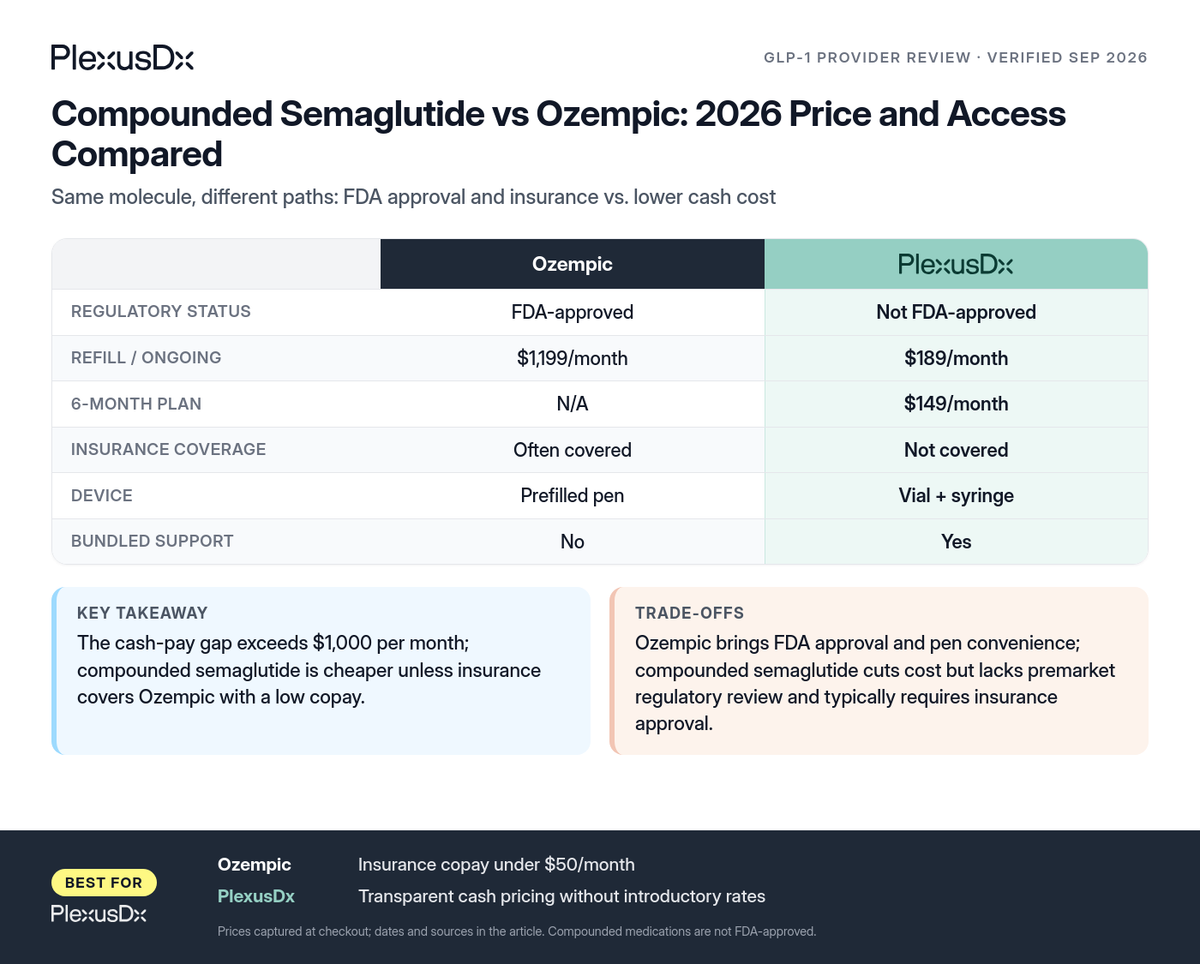
Ozempic and compounded semaglutide both deliver the same active GLP-1 molecule, but their regulatory paths, cost structures, and access models diverge sharply. Ozempic is FDA-approved, typically runs $1,149–$1,199 per four-week supply at cash-pay rates (captured September 4, 2026, via Levity), and often requires prior authorization when billed through insurance. Compounded semaglutide is not FDA-approved, originates from licensed 503A compounding pharmacies, and ranges from $99 to $299 per month across established telehealth providers (verified July–September 2026). Most insurance plans do not reimburse compounded medications, making cash-pay the default pathway. Choosing between the two turns on whether your insurance covers Ozempic at a tolerable copay, whether you value FDA approval, and whether the cash-pay price gap—often $900+ per month—justifies the difference.
Deciding between FDA-approved and compounded semaglutide?
Review our injectable and oral compounded semaglutide options—transparent pricing, no membership fees.
Compare semaglutide options →
At-a-glance comparison
| Factor |
Ozempic (Brand-Name) |
Compounded Semaglutide |
| Regulatory status |
FDA-approved prescription (Novo Nordisk) |
Not FDA-approved; compounded by licensed 503A pharmacies |
| Cash price (monthly) |
~$1,149–$1,199 per ~4-week supply (Levity, Sept 4, 2026) |
$99–$299/month across providers (July–Sept 2026) |
| Insurance coverage |
Variable; often requires prior authorization; copay $0–$300+ depending on plan |
Typically not covered; cash-pay is standard |
| Access model |
Retail or specialty pharmacy; prescription required; may face stock constraints |
Direct-to-patient via telehealth; prescription required; pharmacy network dependent |
| Device |
Prefilled pen |
Vial with syringe or prefilled syringe (provider-dependent) |
| Clinical support |
Varies by prescriber and plan; separate from medication dispensing |
Bundled clinician access, coaching, and support (provider-dependent) |
Sources: Levity pricing page (captured September 4, 2026), PlexusDx signup verification (July–September 2026), provider checkout audits. Insurance coverage varies by plan and indication; confirm reimbursement and copay before filling.
Ozempic pricing: cash-pay and insurance dynamics
Ozempic carries a list price near $1,000–$1,200 per pen (approximately one month's supply), with cash-pay rates documented at $1,149 first month and $1,199 per refill (billed roughly every four weeks, Levity, captured September 4, 2026). Novo Nordisk's prefilled pen design integrates the dose-escalation schedule, and most patients follow a four-week refill cadence.
Insurance coverage is the dominant variable. Patients whose plans cover Ozempic for type 2 diabetes—or off-label for weight management—may face copays ranging from $0 (with manufacturer coupon support, subject to eligibility) to $300 or more per fill. Many plans impose prior authorization, requiring documentation of BMI thresholds, comorbidities, or failed dietary interventions. Weight-management indications are less consistently covered than diabetes indications, and coverage policies shift year to year.
When insurance does not cover Ozempic or the copay approaches the cash-pay rate for compounded alternatives, the economic case for staying on the branded drug hinges on the patient's preference for FDA approval and device convenience. The Ozempic pen is pre-calibrated and requires no separate syringe; compounded semaglutide typically arrives as a vial or prefilled syringe that the patient draws and injects.
Compounded semaglutide pricing: monthly cash rates
Compounded semaglutide operates outside the FDA approval pathway. Licensed 503A compounding pharmacies prepare semaglutide on a per-prescription basis, and telehealth providers bundle the medication with clinician access, support, and shipping. Monthly cash prices vary by provider, dose policy, and commitment length:
-
PlexusDx: $189/month (month-to-month), $169/month (3-month), $149/month (6-month); no membership fee; same price at every dose; medication, clinician access, and shipping included (captured September 20, 2026).
-
OrderlyMeds: $149 first two months prepaid ($74.50/month effective introductory rate), then $149/month ongoing; no separate membership (captured September 4, 2026).
-
Eden: $99/month medication + $99/month membership (ongoing) = $198/month all-in; $39 membership first month (captured September 4, 2026).
-
Found: $289/month (month-to-month cash), or $169/month effective if prepaying $2,028 for 12 months (captured September 4, 2026; prepaid rate is our calculation).
-
Henry Meds: $297/month (month-to-month injection), or $197/month effective if prepaying $2,364 for 12 months (captured September 4, 2026; prepaid rate is our calculation).
-
MEDVi: $179 first month (introductory rate), then $299/month refill; no membership; no contract (captured September 4, 2026).
-
Embody: $299/month; no membership fee; same price at every dose (captured July 17–23, 2026).
-
Peak Wellness: $249/month (month-to-month); lower per-month rates available on 6-month prepaid plans (captured July 17–23, 2026).
-
TrimRx: $299/month at checkout (month-to-month ongoing); advertised $199/month; lower per-month rates on 3-, 6-, and 12-month plans charged upfront (captured July 17–23, 2026).
Introductory rates (OrderlyMeds' $74.50/month effective starter, MEDVi's $179 first month) reduce the first one or two months' cost but revert to the standard refill price thereafter. Multi-month prepaid plans (Found, Henry Meds, Hims & Hers) lower the effective monthly rate but require upfront payment and a commitment period.
Compare PlexusDx compounded semaglutide: $189 month-to-month or $149/month on a 6-month plan
A licensed provider reviews your intake and determines whether a prescription is appropriate for you.
Start My 60-Second Intake →About 60 seconds · $0 charged until provider approval.
Twelve-month cost comparison (like-for-like, month-to-month and prepaid)
The table below normalizes cash-pay costs over 12 months, separating month-to-month rates (no upfront commitment) from prepaid plans (discounted effective rate, full payment required at start). All figures are our calculation from the rates documented above.
| Option |
Month-to-Month (12-mo total) |
Prepaid Annual (12-mo total) |
| Ozempic (Levity cash) |
~$14,237 (1 mo @ $1,149 + 11 mo @ $1,199) |
N/A |
| PlexusDx injection |
$2,268 ($189/mo) |
$1,788 ($149/mo × 12) |
| OrderlyMeds |
$1,639 ($149 starter for 2 mo + $149/mo × 10) |
N/A (starter only) |
| Eden (med + membership) |
$2,316 ($138 first-month rate, then $198/mo × 11) |
N/A |
| Found |
$3,468 ($289/mo × 12) |
$2,028 (prepaid annual) |
| Henry Meds injection |
$3,564 ($297/mo × 12) |
$2,364 (prepaid annual) |
| MEDVi injection |
$3,468 ($179 mo 1 + $299/mo × 11) |
N/A |
| Embody |
$3,588 ($299/mo × 12) |
N/A |
| Peak Wellness |
$2,988 ($249/mo × 12) |
Lower (6-mo prepay available; rate not disclosed) |
| TrimRx |
$3,588 ($299/mo × 12, checkout verified) |
Lower (3/6/12-mo plans; rates not disclosed) |
| Hims & Hers |
N/A (only 6-mo plan documented) |
$2,388 ($1,194 × 2 six-month cycles) |
All 12-month totals are our calculation from provider-published rates. Ozempic figure uses Levity's documented $1,149 first month, $1,199 refill (September 4, 2026). Prepaid plans require full payment upfront. OrderlyMeds starter covers two months; ongoing rate applied for months 3–12. Eden calculation uses $39 + $99 for month 1, then $99 + $99 for months 2–12. Confirm current pricing and eligibility at checkout.
The cash-pay gap between Ozempic and the most affordable compounded options exceeds $12,000 over 12 months. Even the highest-priced compounded providers (Henry Meds month-to-month, Embody, TrimRx) run roughly $10,000 less per year than Ozempic at Levity's documented rate. Insurance coverage can flip this equation: a patient with a $25 monthly Ozempic copay pays $300 per year, far below any compounded rate. Patients should model their own copay and confirm prior-authorization requirements before choosing a pathway.
Regulatory and safety considerations
Compounded medications are not FDA-approved. FDA does not review compounded drugs before marketing for safety, effectiveness, or quality. A licensed clinician determines whether a prescription is appropriate for an individual patient. PlexusDx works with licensed 503A compounding pharmacies.
Ozempic completed Phase III trials, carries FDA approval, and is manufactured under current Good Manufacturing Practice (cGMP) regulations. Compounded semaglutide uses the same active pharmaceutical ingredient but is prepared by individual pharmacies on a per-prescription basis. The FDA does not verify potency, sterility, or stability of compounded drugs before they reach patients. State boards of pharmacy regulate 503A compounders, and compliance varies.
Both pathways require a valid prescription from a licensed clinician. Neither guarantees weight-loss results, and both carry similar side-effect profiles (nausea, gastrointestinal discomfort, injection-site reactions). Adverse events should be reported to the prescribing clinician and, for FDA-approved drugs, to FDA MedWatch.
Insurance vs cash-pay decision tree
The practical choice between Ozempic and compounded semaglutide hinges on five factors:
-
Insurance coverage and copay: If your plan covers Ozempic for your indication (type 2 diabetes or weight management) and your copay is $50 or less per fill, the branded drug is likely the lower-cost option. If your copay exceeds $200 or your plan does not cover GLP-1s, compounded semaglutide becomes economically competitive.
-
Prior authorization complexity: Ozempic often requires prior auth, which may delay start by days or weeks. Compounded telehealth providers typically complete an intake, clinician review, and pharmacy fulfillment within 48–72 hours. Patients who cannot wait for insurance approval may prefer the compounded pathway even if insurance eventually covers Ozempic.
-
FDA approval preference: Patients who prioritize FDA-reviewed manufacturing and clinical-trial data may choose Ozempic regardless of cost. Patients comfortable with 503A compounding oversight and willing to trade regulatory review for cost savings gravitate toward compounded options.
-
Device and injection logistics: Ozempic's prefilled pen is calibrated and pre-set; no separate syringe is required. Compounded semaglutide typically requires drawing from a vial or using a prefilled syringe. Patients with dexterity concerns or needle aversion may find the pen easier.
-
Bundled support: Most compounded telehealth programs include clinician messaging, dosing adjustments, and lifestyle coaching in the monthly fee. Ozempic prescriptions dispensed through retail pharmacies do not bundle ongoing clinician access; patients rely on their prescribing provider's office for support.
Choose Ozempic if…
- Your insurance covers it with a copay below $50 per fill and you can navigate prior authorization without delay.
- You strongly prefer FDA-approved medications and are willing to pay the premium (or your insurance pays it).
- You value the prefilled pen's convenience and do not want to handle vials or syringes.
- Your prescribing physician is managing your GLP-1 therapy within an existing care relationship and you do not need bundled telehealth support.
Choose compounded semaglutide if…
- Your insurance does not cover Ozempic, or your copay exceeds $150 per fill, making cash-pay compounded rates cheaper.
- You want to start quickly without waiting for prior authorization approval.
- You are comfortable with 503A pharmacy compounding and accept the absence of FDA premarket review in exchange for lower cost.
- You prefer an all-inclusive monthly fee that bundles medication, clinician access, dosing adjustments, and shipping.
- You are exploring maintenance therapy and want month-to-month flexibility without insurance paperwork.
Where PlexusDx fits
PlexusDx offers compounded semaglutide injection at transparent, flat monthly rates: $189 month-to-month, $169/month on a 3-month plan, or $149/month on a 6-month plan (no membership fee, same price at every dose, medication and clinician access included). We work with licensed 503A compounding pharmacies and require a clinician-reviewed prescription before fulfillment.
Our model is built for patients who have confirmed that Ozempic's insurance pathway is cost-prohibitive or logistically impractical, and who prefer predictable cash pricing without introductory rates that reset after one or two months. If your insurance copay for Ozempic is $25, Ozempic is the cheaper option. If your copay is $200 or you have no coverage, PlexusDx's $149–$189 monthly rate saves roughly $1,000 per month compared to Ozempic's $1,149–$1,199 cash price.
We do not offer Ozempic or other FDA-approved branded GLP-1s; our focus is compounded semaglutide and tirzepatide for patients who choose the cash-pay compounded pathway. Eligibility, prescription, and dose are determined by a licensed clinician after intake review. We cannot guarantee approval, specific dosing, or weight-loss outcomes.
Methodology and freshness
This comparison synthesizes pricing and access data captured between July 17 and September 20, 2026, through direct provider signup verification, checkout audits, and public pricing-page review. Ozempic cash-pay rates are documented from Levity's published pricing (captured September 4, 2026). Compounded semaglutide rates reflect month-to-month and prepaid plans as published by each provider; introductory and prepaid rates are labeled as such. Twelve-month cost totals are our calculation from the documented monthly rates. Insurance copays vary by plan, indication, and prior-authorization outcome; readers should verify their own copay and coverage before choosing a pathway. Compounded-medication regulatory statements are drawn from FDA guidance. We update pricing quarterly and note conflicts when checkout figures differ from advertised rates. No fee was paid to appear in this comparison; PlexusDx is one of the providers discussed and applies the same evidence standard to itself and competitors.
Frequently Asked Questions
Is compounded semaglutide identical to Ozempic?
Both contain semaglutide as the active ingredient, but Ozempic is FDA-approved and manufactured by Novo Nordisk under cGMP regulations, while compounded semaglutide is prepared by licensed 503A pharmacies on a per-prescription basis and is not FDA-approved. The FDA does not review compounded drugs for safety, effectiveness, or quality before they reach patients.
Will my insurance cover compounded semaglutide?
Most insurance plans do not reimburse compounded GLP-1 medications. Compounded semaglutide is typically a cash-pay option. If your insurance covers Ozempic with a low copay, that is usually the more economical pathway. Confirm your plan's formulary and copay before deciding.
How much does Ozempic cost without insurance?
Cash-pay rates for Ozempic are approximately $1,149 for the first month and $1,199 per refill (roughly every four weeks), totaling around $14,237 over 12 months (Levity, captured September 4, 2026). This is our calculation from the documented per-fill rates and assumes uninterrupted monthly refills.
Can I switch from Ozempic to compounded semaglutide mid-treatment?
Switching is possible if a licensed clinician reviews your current dose and determines an appropriate compounded prescription. Transfers are not automatic, and your new provider cannot guarantee starting at your current Ozempic dose. Allow time for intake review, and do not stop Ozempic until your compounded prescription is confirmed and shipped.
Do compounded semaglutide providers offer prefilled pens like Ozempic?
Most compounded semaglutide arrives as a vial with separate syringes or as prefilled syringes, not the pre-calibrated pen used for Ozempic. Injection technique is similar, but patients draw the dose themselves or use a pre-measured syringe. Some providers offer auto-injector accessories; confirm device options during intake.
Sources
- PlexusDx internal pricing and program documentation (captured September 20, 2026)
- Provider signup verification audits: Found, Henry Meds, Eden, Embody, Peak Wellness, TrimRx (July 17–23, 2026)
- Public pricing-page captures: Levity, MEDVi, OrderlyMeds, Hims & Hers, Ro, WeightWatchers Clinic, Mochi Health (captured September 4, 2026)
- FDA guidance on compounded drugs and 503A pharmacies (accessed September 2026)
Ready to explore compounded semaglutide at transparent cash-pay pricing?
One all-inclusive price covers your online provider visit, prescription, medication, and shipping—no membership, no hidden fees. Complete a short intake and a licensed provider reviews your fit.
Start My Intake →
Compounded medication disclosure: Compounded medications are not FDA-approved. FDA does not review compounded drugs before marketing for safety, effectiveness, or quality. A licensed clinician determines whether a prescription is appropriate for an individual patient. PlexusDx works with licensed 503A compounding pharmacies.
Medical and Editorial Standards
Medical review process: This article was reviewed for medical accuracy, scientific clarity, evidence alignment, and appropriate discussion of genetics, medications, supplements, biomarkers, and health-related claims.
Sources and evidence: PlexusDx educational content is developed using peer-reviewed research, clinical literature, reputable medical references, and, where applicable, public health or regulatory guidance. References are included at the end of the article when scientific, medical, or health-related claims are discussed.
Commercial transparency: PlexusDx offers genetic testing, blood biomarker testing, personalized supplement recommendations, and related precision wellness services. Product mentions are intended to help readers understand available options and should not be interpreted as medical advice.
Important disclaimer: PlexusDx educational content is for informational purposes only and should not be used as a substitute for professional medical advice, diagnosis, or treatment. Always consult a qualified healthcare provider before making decisions about medications, supplements, genetic testing, lab testing, or health-related care.


Share:
Rex MD Semaglutide Pricing — 2026 Pricing, Plans, and Verdict
Wegovy vs Zepbound Online Programs: 2026 Pricing and Plans Compared